

Aquarium Lighting Guide | Planted & Reef Tank | PAR, PUR, PAS
Kelvin, Nanometers, Spectrum
Kelvin, Nanometers, Spectrum
Overview
Recommended Companion Article: PAR in Aquarium Lighting
When choosing your aquarium lighting, there's MUCH MORE to consider than just "WATTS PER GALLON". Back in the days of buying your fluorescent cool white or warm white T12 or T8 lights (often even at hardware stores), this 'rule' was quite useful since we were more comparing "apples to apples". Often this would range from 3 to as much as 5 watts per gallon, but this now is quite outdated for most modern lights.
In fact, the 'Watts Per Gallon' should only be used within the same type & make depending upon what is kept. This is due to the variety of available modern lights with varying lumens per watt, different wavelengths, focused lumens, PAR, PUR, PAS, & RQE. As an example, a high PAR/PUR LED only need about 4% to 15% of typical aquarium T8 or T12 lamps.
Now we generally will start with the PAR for what we intend to utilize our lights for (although many will often use higher PAR readings than necessary). Even then with the many LEDs available, we need to look at input energy versus output energy since often the same input in watts (joules of energy) can have a different output in PAR due to wasted heat energy in drivers, controllers, fans, etc. In fact, these efficiencies just within LED light can vary greatly with some as efficient as .08 watt per mm of PAR (one model of AAP AquaRay) & as inefficient as 2.7 watt per mm of PAR (a Beamsworks LED). Then we get to the QUALITY of the light output as per the application & this too can vary, even with the same PAR output (photons of light), meaning one light with the same PAR reading can be superior over another.
There are other factors I will cover in this article affecting lighting for your aquarium. For example: You cannot compare the output of a 150-watt Metal Halide to a 150-watt outdoor floodlight. Nor an 85-watt standard incandescent to an 85-Watt 6400 K SHO Bulb. What I am trying to say is often it comes down to comparing apples to oranges.
If you are TRULY interested in the "BEST AQUARIUM LIGHTING", Please read this ENTIRE article to understand ALL parameters necessary for your aquarium light determination.
Products described in this article are primarily used because I & other professionals I trust have many years of real-world experience with them. No one should come away with a feeling of obligation to purchase these products, rather a greater understanding of aquarium lighting & their applications. This said, I do not try to appeal to the "cool kids club" of lighting too. My recommendations are based on my experience & research, not being bought out. Many of today's modern lights will work on your planted or reef tank, but often you will find at much lower efficiencies, even though capable. So if you are looking for the best on science & experience, please read on, if you want to be popular just go with what popular forums recommend.
SOME HISTORY/COMMENTARY: Lights as they apply to aquarium use have evolved/changed considerable since I have been in the hobby & professionally employed in aquarium set-up & design. We often used "hardware store" warm white T12 fluorescent lights, just in larger "quantities" to make up for the poor "quality" of light, even while planted freshwater could be kept, not so with ANY photosynthetic reef life. Early on lights such as the "Aquarilux" came out which still was heavier on the "warm" colors, it also had more blue. Later the Trichromatics & Triton lamps came out with spectrums focusing on the daylight 6500 Kelvin temperature, these made growing planted aquariums easier with less lights to do the same job as earlier lights. We also had actinic blue lights become available, these mixed with other lights made it possible in the beginning to keep some photosynthetic reef life, although initially these did not thrive. Later T6 & T5 advancements along with Metal Halide lights allowed us to not only keep delicate photosynthetic reef life, but for this life to thrive. We now have T2, SHO, & LEDs of which the later have lowered considerably the input energy for the quantity of output energy of light that we need for our aquarium keeping applications.
This overview is just a brief explanation of aquarium lighting. It is important to note that Aquarium Lighting is a complex subject, & this article has both more in-depth information as well as some basics. However, this is a subject that, by reading one section, will yield incomplete information. For this reason, I recommend reading the whole article (as well as links provided) for a more thorough understanding (it may take more than one reading). I should also note that while I have years of hands-on professional experience (since 1978), this is a fast-evolving subject of aquarium keeping requiring my constant research & consulting with many others for their scientific expertise/experience. The result is constant changes/updates to this article.
For cynical readers of this article who claim I have a bias: Obviously I do, but then this is based on much research & use. WHY WOULD I RECOMMEND ANY PRODUCT THAT RESEARCH & EXPERIENCE SHOWS TO BE INFERIOR TO ANOTHER? In fact, many of the Lighting Products I recommend and admittedly sell were not even available in the earlier drafts of this article since it was first written in the 1990s & added to the Internet in 2005. It was my research, consulting, & experience that led me to the products I now recommend (which includes the simple math of PAR per wattage used which quickly shows many of the Fad LEDs promoted by so many to be inferior)!!!
As a BRIEF generalization, we are first concerned with INPUT energy, then OUTPUT energy.
This can be further simplistically broken down into these 6 considerations:
• PAR (output energy).
• PUR/Useful Light Energy/Quality of Light as per application (output energy). This is an important factor often missed by aquarium keepers.
• Lumens per watt (input/output energy).
• Lumen focus, as well as restrike (output energy).
• Wattage used (input energy).
• Energy lost as heat via fans, transformers, drivers, method of controlling, etc. (input energy).
Finally, it is still worth noting that even our best man-made lighting is still far inferior to sunlight. So short of placing our aquarium outdoors, all we can do is attempt to emulate at least the most useful aspects of sunlight energy that we can.
In fact, the 'Watts Per Gallon' should only be used within the same type & make depending upon what is kept. This is due to the variety of available modern lights with varying lumens per watt, different wavelengths, focused lumens, PAR, PUR, PAS, & RQE. As an example, a high PAR/PUR LED only need about 4% to 15% of typical aquarium T8 or T12 lamps.
Now we generally will start with the PAR for what we intend to utilize our lights for (although many will often use higher PAR readings than necessary). Even then with the many LEDs available, we need to look at input energy versus output energy since often the same input in watts (joules of energy) can have a different output in PAR due to wasted heat energy in drivers, controllers, fans, etc. In fact, these efficiencies just within LED light can vary greatly with some as efficient as .08 watt per mm of PAR (one model of AAP AquaRay) & as inefficient as 2.7 watt per mm of PAR (a Beamsworks LED). Then we get to the QUALITY of the light output as per the application & this too can vary, even with the same PAR output (photons of light), meaning one light with the same PAR reading can be superior over another.
There are other factors I will cover in this article affecting lighting for your aquarium. For example: You cannot compare the output of a 150-watt Metal Halide to a 150-watt outdoor floodlight. Nor an 85-watt standard incandescent to an 85-Watt 6400 K SHO Bulb. What I am trying to say is often it comes down to comparing apples to oranges.
If you are TRULY interested in the "BEST AQUARIUM LIGHTING", Please read this ENTIRE article to understand ALL parameters necessary for your aquarium light determination.
Products described in this article are primarily used because I & other professionals I trust have many years of real-world experience with them. No one should come away with a feeling of obligation to purchase these products, rather a greater understanding of aquarium lighting & their applications. This said, I do not try to appeal to the "cool kids club" of lighting too. My recommendations are based on my experience & research, not being bought out. Many of today's modern lights will work on your planted or reef tank, but often you will find at much lower efficiencies, even though capable. So if you are looking for the best on science & experience, please read on, if you want to be popular just go with what popular forums recommend.
SOME HISTORY/COMMENTARY: Lights as they apply to aquarium use have evolved/changed considerable since I have been in the hobby & professionally employed in aquarium set-up & design. We often used "hardware store" warm white T12 fluorescent lights, just in larger "quantities" to make up for the poor "quality" of light, even while planted freshwater could be kept, not so with ANY photosynthetic reef life. Early on lights such as the "Aquarilux" came out which still was heavier on the "warm" colors, it also had more blue. Later the Trichromatics & Triton lamps came out with spectrums focusing on the daylight 6500 Kelvin temperature, these made growing planted aquariums easier with less lights to do the same job as earlier lights. We also had actinic blue lights become available, these mixed with other lights made it possible in the beginning to keep some photosynthetic reef life, although initially these did not thrive. Later T6 & T5 advancements along with Metal Halide lights allowed us to not only keep delicate photosynthetic reef life, but for this life to thrive. We now have T2, SHO, & LEDs of which the later have lowered considerably the input energy for the quantity of output energy of light that we need for our aquarium keeping applications.
This overview is just a brief explanation of aquarium lighting. It is important to note that Aquarium Lighting is a complex subject, & this article has both more in-depth information as well as some basics. However, this is a subject that, by reading one section, will yield incomplete information. For this reason, I recommend reading the whole article (as well as links provided) for a more thorough understanding (it may take more than one reading). I should also note that while I have years of hands-on professional experience (since 1978), this is a fast-evolving subject of aquarium keeping requiring my constant research & consulting with many others for their scientific expertise/experience. The result is constant changes/updates to this article.
For cynical readers of this article who claim I have a bias: Obviously I do, but then this is based on much research & use. WHY WOULD I RECOMMEND ANY PRODUCT THAT RESEARCH & EXPERIENCE SHOWS TO BE INFERIOR TO ANOTHER? In fact, many of the Lighting Products I recommend and admittedly sell were not even available in the earlier drafts of this article since it was first written in the 1990s & added to the Internet in 2005. It was my research, consulting, & experience that led me to the products I now recommend (which includes the simple math of PAR per wattage used which quickly shows many of the Fad LEDs promoted by so many to be inferior)!!!
As a BRIEF generalization, we are first concerned with INPUT energy, then OUTPUT energy.
This can be further simplistically broken down into these 6 considerations:
• PAR (output energy).
• PUR/Useful Light Energy/Quality of Light as per application (output energy). This is an important factor often missed by aquarium keepers.
• Lumens per watt (input/output energy).
• Lumen focus, as well as restrike (output energy).
• Wattage used (input energy).
• Energy lost as heat via fans, transformers, drivers, method of controlling, etc. (input energy).
Finally, it is still worth noting that even our best man-made lighting is still far inferior to sunlight. So short of placing our aquarium outdoors, all we can do is attempt to emulate at least the most useful aspects of sunlight energy that we can.
Kelvin Rating
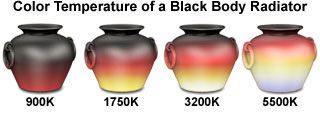
What is meant by Kelvin Temperature of Lights is not the classic interpretation of the meaning of Kelvin.
Light Kelvins: Kelvin is used in the lighting industry to define the Color temperature of a bulb. Higher color temperature lamps above 5500 K are "cool" (green–blue) colors, & lower color temperature lamps below 3000 K are "warm" (yellow–red) colors.
However, Kelvin is ONLY AN INDICATOR of what the light spectrum in nanometers MIGHT be, not an exact prediction, so be careful about comparing light output solely by Kelvin (actual spectrums & PUR are better measurements).
Kelvins, as applied to color temperature of lights, are derived from the actual temperature of a black body radiator. Which is the concept of color temperature based on the relationship between the temperature & radiation emitted by a theoretical standardized material and termed a "black body radiator". This is where the "classic" definition of Kelvin, & how it relates to light, come together. Hypothetically, at cessation of all molecular motion (the black body state of this hypothetical radiator), the temperature is described as being at absolute zero or 0 Kelvin, which is equal to -273 degrees Celsius.
An incandescent filament is very dark, and approaches being a black body radiator, so the actual temperature of an incandescent filament is somewhat close to its color temperature in Kelvins.
Incandescent lamps tend to have a color temperature around 3200 K, but this is true only if they are operating with full voltage. When a lamp is dimmed below its full potential, its filament is not as hot, and it produces less light. The reduced temperature of the filament also reduces the color temperature downward. An incandescent light dimmed to 10% is considerably redder in color than one at 100%.
Another consideration of the color temperature as applied to lights; color temperature does not take into consideration the spectral distribution of a visible light source. In cases where a light source, such as a fluorescent lamp, arc-discharge burner, laser, or gas lamp, do not have a spectral distribution similar to that of a black body radiator.
A few generalized notes about Kelvin: While our coral & plants are not black body radiators, THIS IS IRRELEVANT since Kelvin in our usage is simply a predictor of light spectrums.
• Plant chlorophyll absorbs light at wavelengths of 300 to 700 nm Kelvin rating of about 6400 strikes a good balance here, which is why this is the best Kelvin temperature for freshwater plants (& symbiotic zooxanthellae in corals in shallow, perfect conditions).
• The lower the "K", the more yellow, then red the light appears, such as a 4500 K bulb.
• The higher the "K", the bluer the light appears, such as a 20,000 K bulb.
• Higher Kelvin Color Temperature lights penetrate water more deeply, even more so in saltwater, however there is less of the red "PAR spikes" as well.
• The human eye mostly sees light around 5500K.
• Candle flame = 1850 – 1900 K.
• Sunlight (1 hour after dawn) = 3500 K.
• Typical summer light (sun + sky) = 6500 K.
• Cool white fluorescent = 4200-5500 K.
Different nanometer wavelengths can be used to reach the same Kelvin Temperature; just as 4+5 & 1+8 both equal 9, so can different nanometer wavelengths be used for the same Kelvin Temperature.
An example here would include using warm white & blue, fluorescent lights or LED emitters could also be used): If eleven warm white lights or emitters (3000k) along with one blue light/emitter at 50000k, one would multiply 11 x 3000 + 1 x 50000 = 83000 ÷ 12 (total lights or emitters) = 6916k. In other words, you can obtain an overall 6900 kelvin rating with this combination. Frankly this would provide a very inefficient/poor way to reach a good daylight kelvin since your lights would be very heavy in warm yellows, reds, & some greens, with a less than optimal photosynthetic action spectrum (PAS).
This is why often comparing one 6500K lamp to another can often be "apples to oranges" as for necessary useful light energy (PUR) needed by plants or corals. Another reason why Kelvin ratings are often poor methods to rate modern aquarium lights.
Light Kelvins: Kelvin is used in the lighting industry to define the Color temperature of a bulb. Higher color temperature lamps above 5500 K are "cool" (green–blue) colors, & lower color temperature lamps below 3000 K are "warm" (yellow–red) colors.
However, Kelvin is ONLY AN INDICATOR of what the light spectrum in nanometers MIGHT be, not an exact prediction, so be careful about comparing light output solely by Kelvin (actual spectrums & PUR are better measurements).
Kelvins, as applied to color temperature of lights, are derived from the actual temperature of a black body radiator. Which is the concept of color temperature based on the relationship between the temperature & radiation emitted by a theoretical standardized material and termed a "black body radiator". This is where the "classic" definition of Kelvin, & how it relates to light, come together. Hypothetically, at cessation of all molecular motion (the black body state of this hypothetical radiator), the temperature is described as being at absolute zero or 0 Kelvin, which is equal to -273 degrees Celsius.
An incandescent filament is very dark, and approaches being a black body radiator, so the actual temperature of an incandescent filament is somewhat close to its color temperature in Kelvins.
Incandescent lamps tend to have a color temperature around 3200 K, but this is true only if they are operating with full voltage. When a lamp is dimmed below its full potential, its filament is not as hot, and it produces less light. The reduced temperature of the filament also reduces the color temperature downward. An incandescent light dimmed to 10% is considerably redder in color than one at 100%.
Another consideration of the color temperature as applied to lights; color temperature does not take into consideration the spectral distribution of a visible light source. In cases where a light source, such as a fluorescent lamp, arc-discharge burner, laser, or gas lamp, do not have a spectral distribution similar to that of a black body radiator.
A few generalized notes about Kelvin: While our coral & plants are not black body radiators, THIS IS IRRELEVANT since Kelvin in our usage is simply a predictor of light spectrums.
• Plant chlorophyll absorbs light at wavelengths of 300 to 700 nm Kelvin rating of about 6400 strikes a good balance here, which is why this is the best Kelvin temperature for freshwater plants (& symbiotic zooxanthellae in corals in shallow, perfect conditions).
• The lower the "K", the more yellow, then red the light appears, such as a 4500 K bulb.
• The higher the "K", the bluer the light appears, such as a 20,000 K bulb.
• Higher Kelvin Color Temperature lights penetrate water more deeply, even more so in saltwater, however there is less of the red "PAR spikes" as well.
• The human eye mostly sees light around 5500K.
• Candle flame = 1850 – 1900 K.
• Sunlight (1 hour after dawn) = 3500 K.
• Typical summer light (sun + sky) = 6500 K.
• Cool white fluorescent = 4200-5500 K.
Different nanometer wavelengths can be used to reach the same Kelvin Temperature; just as 4+5 & 1+8 both equal 9, so can different nanometer wavelengths be used for the same Kelvin Temperature.
An example here would include using warm white & blue, fluorescent lights or LED emitters could also be used): If eleven warm white lights or emitters (3000k) along with one blue light/emitter at 50000k, one would multiply 11 x 3000 + 1 x 50000 = 83000 ÷ 12 (total lights or emitters) = 6916k. In other words, you can obtain an overall 6900 kelvin rating with this combination. Frankly this would provide a very inefficient/poor way to reach a good daylight kelvin since your lights would be very heavy in warm yellows, reds, & some greens, with a less than optimal photosynthetic action spectrum (PAS).
This is why often comparing one 6500K lamp to another can often be "apples to oranges" as for necessary useful light energy (PUR) needed by plants or corals. Another reason why Kelvin ratings are often poor methods to rate modern aquarium lights.
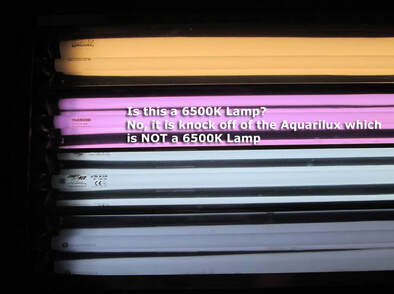
HOWEVER, be wary of comparisons of so called 6500K lights which are clearly NOT all 6500K lights to anyone with any aquarium lighting history experience! While variations in spectrums, and even how the color appears to us, is to be expected as for reasons given, they are not this dramatic also for the reasons already given. In this picture, the two in the top are misleadingly flagged as 6500K, when in fact the pink one is clearly an Aquarilux knock off. The Aquarilux is a popular lamp used to provide color for aquariums back in the 1970s, 80s, & into the 90s. It was NOT marketed as a 6500K or planted aquarium lamp and did NOT perform as well as those that were such as the Trichromatic or Tritons!
What Kelvin Rating for Plants & Corals? Here are some observations made by me and others in the professional aquarium maintenance community, some of these are simple observations, while others were based on more controlled tests. Please understand that these are still generalizations!
The Warm White (2700-3500K) & Cool White (4200-5500K) are typical lighting kelvin ratings used in home lighting and is common of lights sold in hardware stores, etc. While these sources were used years back for both planted and even reef lighting out of necessity (as there were not many options available), these are poor choices due to little essential PUR energy & many cooler white and especially warm white lights are required to delivery this light energy for photosynthetic life.
While these may work and even look pleasing, IF YOU ARE LOOKING FOR THE HIGHEST OUTPUT IN USEFUL ENERGY PER WATT OF ENERGY CONSUMED, these kelvin color lights/emitters should be avoided!
The 6500-8500 Kevin lamps have produced the best terrestrial plant growth and generally the better freshwater plant growth (as this Kelvin lamp generally has more of the 'red' nm spikes needed by "higher" plants, but still has some of the 425-500 nm blue). More importantly if a natural tropical noon time sun 6500 light is utilized, you will get a better balance of all colors over a mixing of colored LED emitters so popular with planted aquarium keepers who like this red light over their red plants who also think this is better for the plants, which simply is not correct based on many years' experiences utilizing many different light sources. It is the balance that you should seek. See the section about Light Time/Placement where I demonstrate that as fluorescent lights age, they produce redder & yellow, yet plant growth decreases (& yes this applies to ANY imbalance of red & yellow light, not just from fluorescent lights).
Please note that saltwater absorbs slightly more light energy than freshwater due to the higher density of the water, so 6500K lights will not penetrate as deeply and are not a good choice for depths over 12 inches.
The 9000-10,000 Kelvin lamps also achieve good growth rates, although slower than the 6500 K bulbs in shallow aquariums. 9000 to 10000K bulbs have produced excellent growth with soft corals & LPS, although slower paced SPS growth. The 10,000K can be a good choice for achieving PAR for better depth penetration than a 6500K bulb (such as 12-20 inch or even deeper aquarium).
The 14,000K light/lamp, will penetrate even more than the 10,000K light while still providing useful PAR (this would be the highest "Daylight" Kelvin temperature I would recommend and still expect good growth in corals. An excellent daylight color for tanks between 15 & 30 inches in depth.
The 20,000 K light/lamp is more blue yet, and brings out all of the fluorescent pigments in many corals making for a very nice appearance. However the many tests and observations show that when used alone, except in tanks over 24 inches, the growth rate of SPS corals can be slowed or even come to a standstill with 20,000 K lamps.
See Reference:
• PUR vs PAR in Aquarium Lighting
Kelvin Summary: The Kelvin rating is another area of comparing apples to apples in lights. The above content is a simplified explanation of Kelvin as it applies to lights. This does not mean that a certain Kelvin bulb is necessarily "better" as factors such as "lumens/PAR per watt", watts of energy used, focused lumens, PAR, & especially PUR MUST be considered as well.
Reference:
• Color Temperature in a Virtual Radiator
This is an interesting resource worth checking out. As well as
Kelvin Color Temperature.
What Kelvin Rating for Plants & Corals? Here are some observations made by me and others in the professional aquarium maintenance community, some of these are simple observations, while others were based on more controlled tests. Please understand that these are still generalizations!
The Warm White (2700-3500K) & Cool White (4200-5500K) are typical lighting kelvin ratings used in home lighting and is common of lights sold in hardware stores, etc. While these sources were used years back for both planted and even reef lighting out of necessity (as there were not many options available), these are poor choices due to little essential PUR energy & many cooler white and especially warm white lights are required to delivery this light energy for photosynthetic life.
While these may work and even look pleasing, IF YOU ARE LOOKING FOR THE HIGHEST OUTPUT IN USEFUL ENERGY PER WATT OF ENERGY CONSUMED, these kelvin color lights/emitters should be avoided!
The 6500-8500 Kevin lamps have produced the best terrestrial plant growth and generally the better freshwater plant growth (as this Kelvin lamp generally has more of the 'red' nm spikes needed by "higher" plants, but still has some of the 425-500 nm blue). More importantly if a natural tropical noon time sun 6500 light is utilized, you will get a better balance of all colors over a mixing of colored LED emitters so popular with planted aquarium keepers who like this red light over their red plants who also think this is better for the plants, which simply is not correct based on many years' experiences utilizing many different light sources. It is the balance that you should seek. See the section about Light Time/Placement where I demonstrate that as fluorescent lights age, they produce redder & yellow, yet plant growth decreases (& yes this applies to ANY imbalance of red & yellow light, not just from fluorescent lights).
Please note that saltwater absorbs slightly more light energy than freshwater due to the higher density of the water, so 6500K lights will not penetrate as deeply and are not a good choice for depths over 12 inches.
The 9000-10,000 Kelvin lamps also achieve good growth rates, although slower than the 6500 K bulbs in shallow aquariums. 9000 to 10000K bulbs have produced excellent growth with soft corals & LPS, although slower paced SPS growth. The 10,000K can be a good choice for achieving PAR for better depth penetration than a 6500K bulb (such as 12-20 inch or even deeper aquarium).
The 14,000K light/lamp, will penetrate even more than the 10,000K light while still providing useful PAR (this would be the highest "Daylight" Kelvin temperature I would recommend and still expect good growth in corals. An excellent daylight color for tanks between 15 & 30 inches in depth.
The 20,000 K light/lamp is more blue yet, and brings out all of the fluorescent pigments in many corals making for a very nice appearance. However the many tests and observations show that when used alone, except in tanks over 24 inches, the growth rate of SPS corals can be slowed or even come to a standstill with 20,000 K lamps.
See Reference:
• PUR vs PAR in Aquarium Lighting
Kelvin Summary: The Kelvin rating is another area of comparing apples to apples in lights. The above content is a simplified explanation of Kelvin as it applies to lights. This does not mean that a certain Kelvin bulb is necessarily "better" as factors such as "lumens/PAR per watt", watts of energy used, focused lumens, PAR, & especially PUR MUST be considered as well.
Reference:
• Color Temperature in a Virtual Radiator
This is an interesting resource worth checking out. As well as
Kelvin Color Temperature.
Namometer Range Spectrum
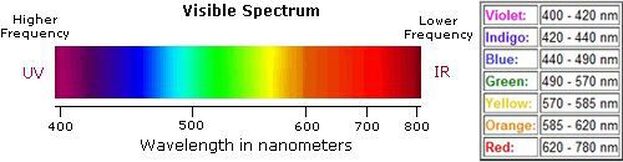
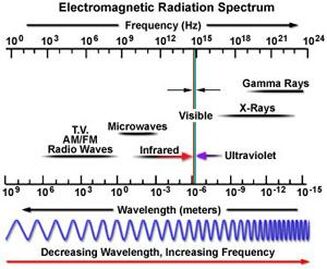
A nanometer scale is used to measure the wavelength of light energy from cosmic rays to radio waves. An actinic bulb will have a Nanometer spike at about 420nm, a UVC bulb about 265nm, & a daylight bulb about multiple spikes from 400 to 700nm. The difference in the wavelength determines how the wave affects its surroundings. It is this wavelength difference that allows short-wave x-ray to pass through walls, while longer-wave visible light cannot pass though the same material; short-wave ultraviolet & x-ray can destroy DNA in living microorganisms & breakdown organic material while visible light will not. All light energy is measured on a "nanometer" (nm) scale. Nanometer means one-billionth of a meter.
This applies to aquariums when we consider the light spectrum & how it applies to our aquarium's individual needs: Red light is the first to be filtered out & can only penetrate a short distance. As light waves penetrate deeper into the water, orange & yellow are lost next. Of all the colors of the spectrum blue light penetrates the deepest. Corals need intense equatorial UVA (actinic) as well as other aspects of PAR. Most higher plants need a balanced PAR light range which includes the blue & two red spikes required for photosynthesis (see section about PAR, PAS & PUR). The Nanometer scale & Kelvin temperatures come together when applied to aquarium lighting this way; Natural sunlight on a clear day registers at 5500- 6500 Kelvin degrees. Kelvin temperatures less than 5500K become redder & yellow & the higher the Kelvin temperature the bluer the light is.
Most photosynthetic marine invertebrates should be kept with lamps of a daylight Kelvin temperature from 6400-14,000 K (higher Kelvin with deeper specimen placement, not necessarily tank depth). 20,000K daylight lamps can also be used for deeper tanks (over 22 inches) and/or supplementation with more blue lights (400nm-490nm).
Photosynthetic invertebrates (many corals, anemones, clams, nudibranch, etc.) also need bluer (400-490nm) than "higher" plants especially as tanks increase in depth, such as the 465-485 blue spectrum. Not only is blue/actinic lighting beneficial to photosynthetic invertebrates, but it is also aesthetically pleasing to the eye and the 420 nm blue in particular brings out the colors of many corals/clams. Osram Oslon now has a "patent pending" LED emitter (the NP Blue) that is the first 'blue' emitter SPECIFICALLY designed for the full PAR spectrum required by marine photosynthetic invertebrates (see LED Section for more).
This applies to aquariums when we consider the light spectrum & how it applies to our aquarium's individual needs: Red light is the first to be filtered out & can only penetrate a short distance. As light waves penetrate deeper into the water, orange & yellow are lost next. Of all the colors of the spectrum blue light penetrates the deepest. Corals need intense equatorial UVA (actinic) as well as other aspects of PAR. Most higher plants need a balanced PAR light range which includes the blue & two red spikes required for photosynthesis (see section about PAR, PAS & PUR). The Nanometer scale & Kelvin temperatures come together when applied to aquarium lighting this way; Natural sunlight on a clear day registers at 5500- 6500 Kelvin degrees. Kelvin temperatures less than 5500K become redder & yellow & the higher the Kelvin temperature the bluer the light is.
Most photosynthetic marine invertebrates should be kept with lamps of a daylight Kelvin temperature from 6400-14,000 K (higher Kelvin with deeper specimen placement, not necessarily tank depth). 20,000K daylight lamps can also be used for deeper tanks (over 22 inches) and/or supplementation with more blue lights (400nm-490nm).
Photosynthetic invertebrates (many corals, anemones, clams, nudibranch, etc.) also need bluer (400-490nm) than "higher" plants especially as tanks increase in depth, such as the 465-485 blue spectrum. Not only is blue/actinic lighting beneficial to photosynthetic invertebrates, but it is also aesthetically pleasing to the eye and the 420 nm blue in particular brings out the colors of many corals/clams. Osram Oslon now has a "patent pending" LED emitter (the NP Blue) that is the first 'blue' emitter SPECIFICALLY designed for the full PAR spectrum required by marine photosynthetic invertebrates (see LED Section for more).
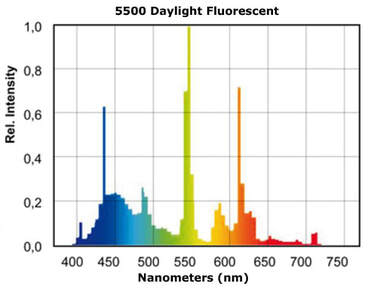
It is noteworthy that Fluorescent and even more so incandescent lights produce a lot of yellow & green nanometer light, which research indicates is mostly wasted energy in terms of the needs or freshwater plants & SPS Corals. This is where an LED Aquarium Light or Metal Halide excel as there is often less of the less efficient yellow/green light.
See the picture to the above that shows a T8 5500 daylight aquarium light that is commonly sold, this graph clearly shows the less efficient green/yellow energy as well as the incorrect spike in orange rather than the correct PAR spike in red 630+ nm.
It is also noteworthy that many "terrestrial plant lights" as well as many aquarium plant lights (often of lower in kelvin temperature) have more "red nanometer spikes" than higher kelvin 6500k, 10,000k & higher lamps. The problem with these lights is that while all plants utilizing photosynthesis require the same essential ABCs of PAR (see the PAR section), the facts of light energy penetrating water requires higher kelvin (6500k +) be added to provide maximum PUR (see Useful light energy/PUR section). Aquatic Plants and corals have adapted/evolved to the natural light energy at certain depth of water and the misguided attempt to adapt these terrestrial plant lights is not going to be 100% effective as a light with more water penetrating blue & slightly lower red nm energy.
See the picture to the above that shows a T8 5500 daylight aquarium light that is commonly sold, this graph clearly shows the less efficient green/yellow energy as well as the incorrect spike in orange rather than the correct PAR spike in red 630+ nm.
It is also noteworthy that many "terrestrial plant lights" as well as many aquarium plant lights (often of lower in kelvin temperature) have more "red nanometer spikes" than higher kelvin 6500k, 10,000k & higher lamps. The problem with these lights is that while all plants utilizing photosynthesis require the same essential ABCs of PAR (see the PAR section), the facts of light energy penetrating water requires higher kelvin (6500k +) be added to provide maximum PUR (see Useful light energy/PUR section). Aquatic Plants and corals have adapted/evolved to the natural light energy at certain depth of water and the misguided attempt to adapt these terrestrial plant lights is not going to be 100% effective as a light with more water penetrating blue & slightly lower red nm energy.
LUX
A measure of the intensity of light (referred to the photometry of light), one lux is equal to one lumen per square meter. This is another area of comparing apples to apples in lights, not just watts. It is noteworthy that a LUX Reading ONLY reports light intensity to which the HUMAN EYE is most sensitive (green light).
While this measurement only includes light visible by humans, this can still be a useful tool for freshwater plants & most corals in marine reef aquariums. When the Lux is not enough, the zooxanthellae (inside of corals tissues) do not create plentiful oxygen. The minimum light intensity should be no less than 3,000-lux when it reaches the deepest part of the aquarium. You can over light your coral to a light saturation point (quite hard in my experience, but this should be noted), maximum Lux should be no more than 100,000 to 120,000. By comparison Lux in tropical reefs has been measured to be between 110,000 and 120,000 Lux at the surface of the reef and 20,000-25,000 Lux one meter below the surface.
While this measurement only includes light visible by humans, this can still be a useful tool for freshwater plants & most corals in marine reef aquariums. When the Lux is not enough, the zooxanthellae (inside of corals tissues) do not create plentiful oxygen. The minimum light intensity should be no less than 3,000-lux when it reaches the deepest part of the aquarium. You can over light your coral to a light saturation point (quite hard in my experience, but this should be noted), maximum Lux should be no more than 100,000 to 120,000. By comparison Lux in tropical reefs has been measured to be between 110,000 and 120,000 Lux at the surface of the reef and 20,000-25,000 Lux one meter below the surface.
PAR
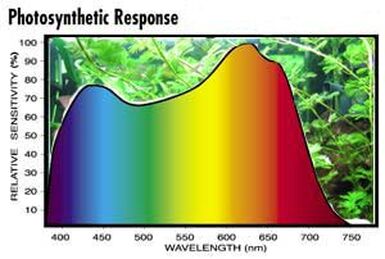
PAR is an important and accepted starting point to estimate light energy for our photosynthetic aquarium keeping needs. We measure PAR via µMolm which is a unit of measure (more about measurement later). While PAR is important, it is often incorrectly used as the only measure by both marine & freshwater plant keeping aquarists, especially by many marketing pros and popular video channels when PUR/PAS/RQE is ALSO important and should be considered.
PAR is the abbreviation for Photosynthetically Active Radiation which is the spectral range of solar light from 400 to 700 nanometers that is generally accepted as needed by plants & symbiotic zooxanthellae algae for photosynthesis (Zooxanthellae are single-celled algae that live in the tissues of animals such as corals, clams, & anemones). It is also noteworthy that while outside of the accepted PAR, a study using infrared (IR) LEDs of 880 nm & 935 nm on etiolated oat seedlings showed leaf emergence, so these parameters may someday need better defining (see Reference at the end of article).
The graph above is only meant to show the boundaries of currently accepted PAR light and the relative quantum efficiency (RQE) therein.
UVA to 550 nm contains the absorption bandwidth of chlorophylls a, c², and peridinin (the light-harvesting carotenoid, a pigment related to chlorophyll). The photons of light energy within these spectrums are more energetic and by themselves tend to provide more plant growth. 620-720nm is the red absorption bandwidth of chlorophylls a and c².
Photons at shorter wavelengths (UVC) tend to be so energetic that they can be damaging to cells and tissues; fortunately, they are mostly filtered out by the ozone layer in the stratosphere. Green light occupies the middle spectrum and is partly why chlorophyll is green due to the reflective properties (30%).
Lights that produce light energy under 500nm will produce a lower PAR reading for a given energy input (wattage), not because less energy is emitted, rather because most PAR meters are less accurate below 500nm. Lights that occupy mostly the middle spectrum (500-600/ green-yellow) such as "Warm White (2700- 3500K) will produce LESS EFFICIENT PAR, in other words less PUR (which is discussed in more depth in the next section). This does not mean that these spectrums are totally useless either as noted by cited updated resources within this article such as Oregon State Univ.
PAR is the abbreviation for Photosynthetically Active Radiation which is the spectral range of solar light from 400 to 700 nanometers that is generally accepted as needed by plants & symbiotic zooxanthellae algae for photosynthesis (Zooxanthellae are single-celled algae that live in the tissues of animals such as corals, clams, & anemones). It is also noteworthy that while outside of the accepted PAR, a study using infrared (IR) LEDs of 880 nm & 935 nm on etiolated oat seedlings showed leaf emergence, so these parameters may someday need better defining (see Reference at the end of article).
The graph above is only meant to show the boundaries of currently accepted PAR light and the relative quantum efficiency (RQE) therein.
UVA to 550 nm contains the absorption bandwidth of chlorophylls a, c², and peridinin (the light-harvesting carotenoid, a pigment related to chlorophyll). The photons of light energy within these spectrums are more energetic and by themselves tend to provide more plant growth. 620-720nm is the red absorption bandwidth of chlorophylls a and c².
Photons at shorter wavelengths (UVC) tend to be so energetic that they can be damaging to cells and tissues; fortunately, they are mostly filtered out by the ozone layer in the stratosphere. Green light occupies the middle spectrum and is partly why chlorophyll is green due to the reflective properties (30%).
Lights that produce light energy under 500nm will produce a lower PAR reading for a given energy input (wattage), not because less energy is emitted, rather because most PAR meters are less accurate below 500nm. Lights that occupy mostly the middle spectrum (500-600/ green-yellow) such as "Warm White (2700- 3500K) will produce LESS EFFICIENT PAR, in other words less PUR (which is discussed in more depth in the next section). This does not mean that these spectrums are totally useless either as noted by cited updated resources within this article such as Oregon State Univ.
Important Definitions as it applies PAR in plants & zooxanthellae algae:
• Phototropic response: Having a tendency to move in response to light. Basically, this is the Chlorophyll containing plant or algae "moving" to respond to a positive light source to begin the process of photosynthesis (initial growth of plants, zooxanthellae, etc.).
• Photosynthetic response: During this time, the molecules needed for photosynthesis gradually reach operating levels which begins when energy from light is absorbed by proteins called photosynthetic reaction centers that contain chlorophylls.
• Chlorophyll synthesis: Occurring in chloroplasts, this is the chemical reactions and pathways by the plant hormone cytokinin soon after exposure to the correct Nanometers wave length , that traps the energy of sunlight for photosynthesis and exists in several forms, the most abundant being Chlorophyll A. This results in continued growth of a plant, algae, zooxanthellae and the ability to "feed" & propagate. Without this aspect of PAR, zooxanthellae & plants cannot properly "feed" propagate resulting is stunted freshwater plant growth, and eventually poor coral health in reef tanks. This is also known as the Photosynthetic Action Spectrum (PAS).
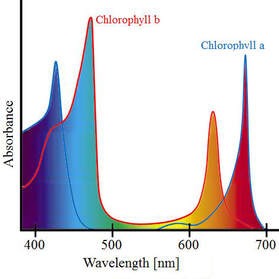
• Chlorophyll A: A type of chlorophyll that is the most common photosynthetic organisms predominant in all higher plants, red & green algae higher plants, red & green algae. It is best at absorbing wavelength in the 400-450 nm & 650-700 nm.
• Chlorophyll B: The chlorophyll that occurs only in plants & green algae. It functions as a light harvesting chlorophyll pigment that pass on the light excitation to chlorophyll a. It absorbs well at wavelength of 450-500 nm & 600-650 nm.
Since many photosynthetic organisms live where light in higher spectrums of PAS such as 600nm & higher penetrate less if at all (in particular algae, zooxanthellae, & cynaobacteria), many have adapted to ways to still harvest this light energy. These organisms use Phycobilisomes which are light harvesting antennae of photosystem II (Chlorophyll synthesis in the Photosynthic Action Spectrum-PAS).
For this reason it is noteworthy that while any light within the PAR range can be used, providing light energy outside certain proven/evolved aspects of PAS can result in poor growth or allowing of less desirable algae to out compete plants or coral we are attempting to cultivate. This why it is a FACT that while certain lights may keep photosynthetic life, less than optimum spectrums found in many of the inferior lights will either produce lessor results and/or require more input light energy for the same results as say a high PAS & PUR light such as the AAP AquaRay.
Reference:
• Aquarium Algae Control: BBA
Further PAR Information: As a light energy penetrates deeper through water, these need to move slightly "left" (lower) on the nanometer graph so as to allow for optimum use of PAR (in other words Photosynthetically useful radiation; please see the PUR/PAS section). This can vary with light type though as not all so-called daylight bulbs are the same, see the PUR & PAS section of this article.
Besides the obvious depth penetration, it is also noteworthy that most zooanthellic algae need more of the blue spike than "higher plants", hence the popularity of actinic lights for reef aquariums. However the general optimum nanometer range is about 450-485nm. For this reason it is a good idea to have extra actinic for corals/clams that depend upon zooanthellic algae, while at the same time limiting blue/actinic in freshwater aquariums to avoid excessive green algae growth. An advantage of the latest technology LED lights is having a more precise 450-485nm blue as well as some 420-450 nm Fiji/violet lights/emitters for certain deeper reef specimens.
As well, a popular trend in LED lighting is to utilize NUV light /emitters that emit light energy between 300-400 nm, HOWEVER as per current known science this light energy is is mostly useless for your photosynthetic life and is generally WASTED LIGHT ENERGY! Part of the reason for this trend is that this makes many corals pop with color since this light range is similar to a black light, but if used, this light energy SHOULD NOT be counted as part of your necessary light energy. As an example, if your Light is 140 watts but has 20 watts as NUV blue, you essentially have a 120 watt light!
Planted Freshwater Aquariums: It is also important to note that freshwater algae also prefer more of the "blue" light so the excessive use of actinic blue lighting should be avoided in planted freshwater aquariums, as well the use of more blue nanometer or higher Kelvin Daylight (14,000K or especially 20,000K) should also be avoided in all but the deepest tanks or in tanks with heavy amounts of C02. Otherwise many freshwater plants may not be able to "out compete" against some algae such as hair algae.
More recent studies show that UVB radiation can bleach coral, so the use of blue lighting under 320nm should be avoided!
• Phototropic response: Having a tendency to move in response to light. Basically, this is the Chlorophyll containing plant or algae "moving" to respond to a positive light source to begin the process of photosynthesis (initial growth of plants, zooxanthellae, etc.).
• Photosynthetic response: During this time, the molecules needed for photosynthesis gradually reach operating levels which begins when energy from light is absorbed by proteins called photosynthetic reaction centers that contain chlorophylls.
• Chlorophyll synthesis: Occurring in chloroplasts, this is the chemical reactions and pathways by the plant hormone cytokinin soon after exposure to the correct Nanometers wave length , that traps the energy of sunlight for photosynthesis and exists in several forms, the most abundant being Chlorophyll A. This results in continued growth of a plant, algae, zooxanthellae and the ability to "feed" & propagate. Without this aspect of PAR, zooxanthellae & plants cannot properly "feed" propagate resulting is stunted freshwater plant growth, and eventually poor coral health in reef tanks. This is also known as the Photosynthetic Action Spectrum (PAS).
• Chlorophyll A: A type of chlorophyll that is the most common photosynthetic organisms predominant in all higher plants, red & green algae higher plants, red & green algae. It is best at absorbing wavelength in the 400-450 nm & 650-700 nm.
• Chlorophyll B: The chlorophyll that occurs only in plants & green algae. It functions as a light harvesting chlorophyll pigment that pass on the light excitation to chlorophyll a. It absorbs well at wavelength of 450-500 nm & 600-650 nm.
Since many photosynthetic organisms live where light in higher spectrums of PAS such as 600nm & higher penetrate less if at all (in particular algae, zooxanthellae, & cynaobacteria), many have adapted to ways to still harvest this light energy. These organisms use Phycobilisomes which are light harvesting antennae of photosystem II (Chlorophyll synthesis in the Photosynthic Action Spectrum-PAS).
For this reason it is noteworthy that while any light within the PAR range can be used, providing light energy outside certain proven/evolved aspects of PAS can result in poor growth or allowing of less desirable algae to out compete plants or coral we are attempting to cultivate. This why it is a FACT that while certain lights may keep photosynthetic life, less than optimum spectrums found in many of the inferior lights will either produce lessor results and/or require more input light energy for the same results as say a high PAS & PUR light such as the AAP AquaRay.
Reference:
• Aquarium Algae Control: BBA
Further PAR Information: As a light energy penetrates deeper through water, these need to move slightly "left" (lower) on the nanometer graph so as to allow for optimum use of PAR (in other words Photosynthetically useful radiation; please see the PUR/PAS section). This can vary with light type though as not all so-called daylight bulbs are the same, see the PUR & PAS section of this article.
Besides the obvious depth penetration, it is also noteworthy that most zooanthellic algae need more of the blue spike than "higher plants", hence the popularity of actinic lights for reef aquariums. However the general optimum nanometer range is about 450-485nm. For this reason it is a good idea to have extra actinic for corals/clams that depend upon zooanthellic algae, while at the same time limiting blue/actinic in freshwater aquariums to avoid excessive green algae growth. An advantage of the latest technology LED lights is having a more precise 450-485nm blue as well as some 420-450 nm Fiji/violet lights/emitters for certain deeper reef specimens.
As well, a popular trend in LED lighting is to utilize NUV light /emitters that emit light energy between 300-400 nm, HOWEVER as per current known science this light energy is is mostly useless for your photosynthetic life and is generally WASTED LIGHT ENERGY! Part of the reason for this trend is that this makes many corals pop with color since this light range is similar to a black light, but if used, this light energy SHOULD NOT be counted as part of your necessary light energy. As an example, if your Light is 140 watts but has 20 watts as NUV blue, you essentially have a 120 watt light!
Planted Freshwater Aquariums: It is also important to note that freshwater algae also prefer more of the "blue" light so the excessive use of actinic blue lighting should be avoided in planted freshwater aquariums, as well the use of more blue nanometer or higher Kelvin Daylight (14,000K or especially 20,000K) should also be avoided in all but the deepest tanks or in tanks with heavy amounts of C02. Otherwise many freshwater plants may not be able to "out compete" against some algae such as hair algae.
More recent studies show that UVB radiation can bleach coral, so the use of blue lighting under 320nm should be avoided!
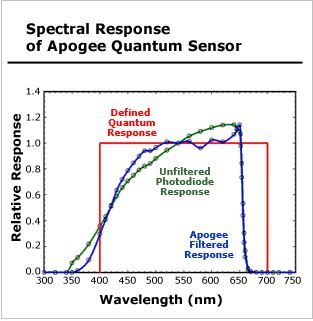
Measuring PAR: Although Kelvins (as well as LUX conversions using questionable LUX to PAR conversion factors) are ways of getting rough estimates of PAR, only a Specific PAR Meter (also called Quantum Light Meters) which uses a standardized unit of measure can give you the best measurement of this aspect of determining your tanks lighting requirements (both at the surface and under the surface).
Currently accepted numbers measured as µMol•m²•sec (also referred to as micro mols, mm, or mmol) are 50 mmol for most plants or corals such as Nemezophyllia, while Acropora can require higher PAR outputs. Keep in mind though, that if one light is using a shotgun approach to achieving a high PAR reading with wasted energy in spectrums outside known needed PUR & PAS, you may need a higher PAR reading, while the reverse may be true of a very efficient PUR light that might achieve excellent results at 50 mm compared to the "shotgun" light that might require 200 mm for the same corals or plants to achieve good results. It is noteworthy that a study of a Coral Farm in Bali showed no more than 200 PAR from noontime tropical sunlight at the depth the acropora were being grown!
Reference:
• PUR, PAS, RQE, PAR in Aquarium Lighting.
HOWEVER, keep in mind that a PAR Meter is NOT accurate in important light energy spikes WITHIN the 400 to 700 nanometer range, so while one light might measure a higher PAR mmol reading, another light might be still superior due to the more important PUR & PAS output. This is where I have found the use of a PAR Meter SOLELY to determine light efficiency overrated.
As an example, understanding PAR numbers, just within the SAME BRAND of emitters & LED lights; using the same energy input of 12 joules (watts) at 400mm we know the measured µMolm of the CRee XT-E Fiji Blue is 38 µMolm while the CRee XB-D 6500K Natural daylight is 61 µMolm. BOTH use the same amount of energy, and in fact the Fiji Blue is actually deeper penetrating, YET the Natural Daylight produces much more light energy as expressed in PAR/µMolm! Looked at another way, if you were to increase the number of emitters of the XT-E Fiji Blue to equal the XB-D 6500K (approximately 37%), would you now suddenly be able to say this light would work perfectly over one's high light planted aquarium? Of course not! Even if you could, this also makes the point of how one more similar LED or other light can have a higher useful light energy output (PUR) for the less input of energy as expressed in watts/joules. This is not to say the XT-E Fiji Blue is poor emitter, only that one needs to take PAR/µMolm measurements in context & that you cannot compare apples to oranges. One could also make similar comparisons with cool white T8 versus 6500K LEDs or even one 6500K light to another 6500K light.
Some organisms, such as Cyanobacteria, purple bacteria & Heliobacteria, can make use of the unusable light discarded by the plant kingdom, in this case, light outside the PUR range required by plants, which is why Cyanobacteria thrive in lighting conditions that include more yellow light energy.
Reference:
• Red Slime Cyanobacteria
Further reference:
• Photosynthetically Active Radiation
Fish Health: Many recent studies have shown the importance of full spectrum lighting as it relates to health in humans & animals, can be extrapolated to fish as well for a disease prevention which is why good lighting should not be restricted to Reef Marine or Planted Freshwater Aquariums, but to fish only salt or freshwater tanks as well.
Further Reading:
• Aquarium Disease Prevention
Currently accepted numbers measured as µMol•m²•sec (also referred to as micro mols, mm, or mmol) are 50 mmol for most plants or corals such as Nemezophyllia, while Acropora can require higher PAR outputs. Keep in mind though, that if one light is using a shotgun approach to achieving a high PAR reading with wasted energy in spectrums outside known needed PUR & PAS, you may need a higher PAR reading, while the reverse may be true of a very efficient PUR light that might achieve excellent results at 50 mm compared to the "shotgun" light that might require 200 mm for the same corals or plants to achieve good results. It is noteworthy that a study of a Coral Farm in Bali showed no more than 200 PAR from noontime tropical sunlight at the depth the acropora were being grown!
Reference:
• PUR, PAS, RQE, PAR in Aquarium Lighting.
HOWEVER, keep in mind that a PAR Meter is NOT accurate in important light energy spikes WITHIN the 400 to 700 nanometer range, so while one light might measure a higher PAR mmol reading, another light might be still superior due to the more important PUR & PAS output. This is where I have found the use of a PAR Meter SOLELY to determine light efficiency overrated.
As an example, understanding PAR numbers, just within the SAME BRAND of emitters & LED lights; using the same energy input of 12 joules (watts) at 400mm we know the measured µMolm of the CRee XT-E Fiji Blue is 38 µMolm while the CRee XB-D 6500K Natural daylight is 61 µMolm. BOTH use the same amount of energy, and in fact the Fiji Blue is actually deeper penetrating, YET the Natural Daylight produces much more light energy as expressed in PAR/µMolm! Looked at another way, if you were to increase the number of emitters of the XT-E Fiji Blue to equal the XB-D 6500K (approximately 37%), would you now suddenly be able to say this light would work perfectly over one's high light planted aquarium? Of course not! Even if you could, this also makes the point of how one more similar LED or other light can have a higher useful light energy output (PUR) for the less input of energy as expressed in watts/joules. This is not to say the XT-E Fiji Blue is poor emitter, only that one needs to take PAR/µMolm measurements in context & that you cannot compare apples to oranges. One could also make similar comparisons with cool white T8 versus 6500K LEDs or even one 6500K light to another 6500K light.
Some organisms, such as Cyanobacteria, purple bacteria & Heliobacteria, can make use of the unusable light discarded by the plant kingdom, in this case, light outside the PUR range required by plants, which is why Cyanobacteria thrive in lighting conditions that include more yellow light energy.
Reference:
• Red Slime Cyanobacteria
Further reference:
• Photosynthetically Active Radiation
Fish Health: Many recent studies have shown the importance of full spectrum lighting as it relates to health in humans & animals, can be extrapolated to fish as well for a disease prevention which is why good lighting should not be restricted to Reef Marine or Planted Freshwater Aquariums, but to fish only salt or freshwater tanks as well.
Further Reading:
• Aquarium Disease Prevention
RQE, PAS, & PUR, "Quality of Light"/"Useful Light Energy"
PUR (Photosynthetically Usable Radiation) is something aquarium keepers should concern themselves with along with PAR in providing correct lighting since it describes the quality of light photons as per application.
PUR cannot be dismissed as some so-called lighting experts have attempted to do based on their short time in the professional aquarium keeping industry, as we have already clearly established (as per the Overview section) that we found that once more precisely tuned spectrum fluorescent lights became available, we could grow aquarium plants more efficiently and with some advancements, this made the difference of not keeping photosynthetic marine organisms at all!!! I should note that some of these advancements were comparing apples to apples; T12 to T12 such as a warm white to a Trichromatic or an actinic (which rules out lumens per watt and other measurements and leaves the FACT of PUR).
Another term is Photosynthetic Action Spectrum (PAS). I should point out that while the terms PAS & PUR have a lot in common, there is a difference in that PAS is most simply stated as the spectrum where "chlorophyll is much more efficient at using the red & blue spectrums of light to carry out photosynthesis. Therefore, the action spectrum graph would show spikes above the wavelengths representing the colors red & blue."
Reference:
• Action spectrum - Wikipedia
While PUR also encompasses this too it also can simply refer to all light spectrums within PAR with emphasis on the more efficient spectrums rather than the less efficient spectrums such as yellow & green. Or stated another way, the portion of PAR, which is more efficiently absorbed by plants & zooxanthellae photopigments thereby stimulating photosynthesis. We can state PUR one more way, whereas PAR is the most important quantity of light, "PUR is the quality of light as per application".
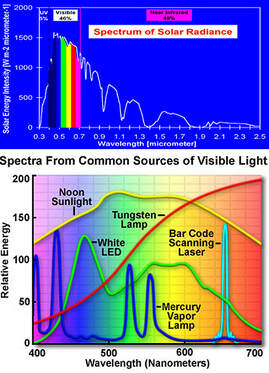
The picture above depicts both full solar radiation that reaches the earth as well as how a few different man-made light sources fit into the visible/PAR aspect of this spectrum. What is noteworthy is how much radiation falls outside the PAR, in particular the longer frequency wave lengths going into radio waves. There is much that we also do not know, since photosynthetic plants, zooxanthellae algae, etc. might also be using radiant energy we do not know about. What we do know is that since UVC is not reaching the earth's surface and that even UVB only reaches in small amounts (if at all during certain times of the day and seasons), that it is likely this is mostly useless for our application.
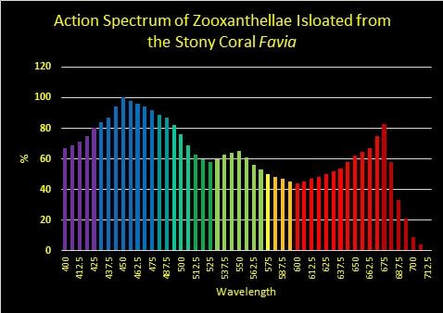
It is also noteworthy that as we gain knowledge, we can in fact map the optimal PUR for a given species such as picture/graph below for the stony coral "Favia" which is a species that is more adapted at deriving energy from the middle spectrums, albeit still less efficiently.
PUR cannot be dismissed as some so-called lighting experts have attempted to do based on their short time in the professional aquarium keeping industry, as we have already clearly established (as per the Overview section) that we found that once more precisely tuned spectrum fluorescent lights became available, we could grow aquarium plants more efficiently and with some advancements, this made the difference of not keeping photosynthetic marine organisms at all!!! I should note that some of these advancements were comparing apples to apples; T12 to T12 such as a warm white to a Trichromatic or an actinic (which rules out lumens per watt and other measurements and leaves the FACT of PUR).
Another term is Photosynthetic Action Spectrum (PAS). I should point out that while the terms PAS & PUR have a lot in common, there is a difference in that PAS is most simply stated as the spectrum where "chlorophyll is much more efficient at using the red & blue spectrums of light to carry out photosynthesis. Therefore, the action spectrum graph would show spikes above the wavelengths representing the colors red & blue."
Reference:
• Action spectrum - Wikipedia
While PUR also encompasses this too it also can simply refer to all light spectrums within PAR with emphasis on the more efficient spectrums rather than the less efficient spectrums such as yellow & green. Or stated another way, the portion of PAR, which is more efficiently absorbed by plants & zooxanthellae photopigments thereby stimulating photosynthesis. We can state PUR one more way, whereas PAR is the most important quantity of light, "PUR is the quality of light as per application".
The picture above depicts both full solar radiation that reaches the earth as well as how a few different man-made light sources fit into the visible/PAR aspect of this spectrum. What is noteworthy is how much radiation falls outside the PAR, in particular the longer frequency wave lengths going into radio waves. There is much that we also do not know, since photosynthetic plants, zooxanthellae algae, etc. might also be using radiant energy we do not know about. What we do know is that since UVC is not reaching the earth's surface and that even UVB only reaches in small amounts (if at all during certain times of the day and seasons), that it is likely this is mostly useless for our application.
It is also noteworthy that as we gain knowledge, we can in fact map the optimal PUR for a given species such as picture/graph below for the stony coral "Favia" which is a species that is more adapted at deriving energy from the middle spectrums, albeit still less efficiently.
It is therefore reasonable to attempt to duplicate the sun's radiant energy that reaches the earth's surface which the Daylight (6500K) LED emitter is reasonably close when compared to the other light sources. Obviously once water is thrown into the equation, more blue is going to be needed, as well we must take into account the 20-30% reflection of green light.
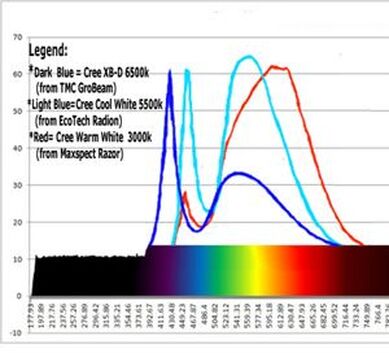
The picture below demonstrates how three LED emitters of equal lumen & PAR output can be quite different in PUR and thus more of the less efficient yellow/green energy.
The other term that is thrown around is "Quantum efficiency"; this term generally refers to the efficiency to incident photon to converted electron (IPCE) ratio of a photosensitive device which predicts a 30% lower efficiency in green spectrum (see diagram in PAR section). 0There has been a lot of confusion about this subject, especially when considering LED lights, as many sellers and aquarium keeping personalities with little background will hype high PAR values while ignoring PUR. Often terminology is confused or "Red Herring" type arguments are made to confuse the subject, but regardless of what you call it by, we have had a general knowledge of PUR, RQE, & PAS for some time.
Many people will think PUR is good in theory but think it cannot be applied to every single species we are trying to grow under water. While we don't know every species and its preferred nm of light prefers, we do know the light, which triggers photosynthesis in an organism as well as efficiencies based on real world tests.
The picture below demonstrates how three LED emitters of equal lumen & PAR output can be quite different in PUR and thus more of the less efficient yellow/green energy.
The other term that is thrown around is "Quantum efficiency"; this term generally refers to the efficiency to incident photon to converted electron (IPCE) ratio of a photosensitive device which predicts a 30% lower efficiency in green spectrum (see diagram in PAR section). 0There has been a lot of confusion about this subject, especially when considering LED lights, as many sellers and aquarium keeping personalities with little background will hype high PAR values while ignoring PUR. Often terminology is confused or "Red Herring" type arguments are made to confuse the subject, but regardless of what you call it by, we have had a general knowledge of PUR, RQE, & PAS for some time.
Many people will think PUR is good in theory but think it cannot be applied to every single species we are trying to grow under water. While we don't know every species and its preferred nm of light prefers, we do know the light, which triggers photosynthesis in an organism as well as efficiencies based on real world tests.
Another misapplication that is often applied in certain aquarium keeping circles where they have apparently not done their research into the history of aquarium lighting as per PUR is to compare a high PUR light to a lower PUR light of much higher input wattage. As an example, I have seen the Ocean Revive LED of 120 watts that is a larger fixture with a larger footprint compared to an AAP AquaRay NP 2000 Reef White that only has 30 watts, then state the AquaRay is under powered. However, if you match input wattage, you will in fact get much more raw light as well as useful light if four of the AquaRays were to be compared (which in reality, you would likely not need this many to do the job).
A little history: Since I have been in the industry on the research and aquarium system design side since 1978. I have called this subject "useful light energy" since at least 1985. Then, I read elsewhere that the more scientific terms of PUR, RQE, & PAS. This explained it well, based on feedback from clients and others in the industry despite others attack upon this term. Frankly a new term that I have heard thrown around that I think is less vague would be "Quality of Light per Application".
The ability of newer technology lights to pinpoint the exact nanometer spectrums needed for PUR in output results in much less wasted energy and allows for a light of considerably lower wattage to actually out produce another light of higher wattage. Even the best of fluorescent lights that are a Kelvin temperature of 6500K, use a percentage of their light energy in the yellow & green light spectrum which is much less efficient for aquarium plants or corals, although some green light can actually improve growth when less than 24% of overall light spectrum.
A little history: Since I have been in the industry on the research and aquarium system design side since 1978. I have called this subject "useful light energy" since at least 1985. Then, I read elsewhere that the more scientific terms of PUR, RQE, & PAS. This explained it well, based on feedback from clients and others in the industry despite others attack upon this term. Frankly a new term that I have heard thrown around that I think is less vague would be "Quality of Light per Application".
The ability of newer technology lights to pinpoint the exact nanometer spectrums needed for PUR in output results in much less wasted energy and allows for a light of considerably lower wattage to actually out produce another light of higher wattage. Even the best of fluorescent lights that are a Kelvin temperature of 6500K, use a percentage of their light energy in the yellow & green light spectrum which is much less efficient for aquarium plants or corals, although some green light can actually improve growth when less than 24% of overall light spectrum.
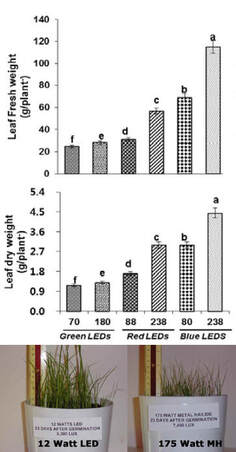
The picture above displays how quality of light or "useful light energy" plays out in real world tests.
Since it is well established that a photon is a photon and it is the quantity that certainly makes the most difference (PAR is quantity), we still cannot ignore the quality of the photon of which the only difference of a photon is the wavelength and frequency (energy). The first graph shows how red, green, & red-light growth based on weight of lettuce. It is clear from the picture that the green light is only 50% of the efficiency of red & only 20% of the efficiency of blue. The second photo demonstrates how one light (the Metal Halide) has much more input energy (joules) and even after the known massive loss of input energy, it still has more photons (expressed as lumens here) than the 6500K Generic Gro Light LED, yet the outcome of growth is dramatic!
Both these examples demonstrate how photosynthesis and plant growth obviously favors photons of specific frequencies!
For a further explanation, please read this article:
• Real World Application of RQE, PAR. PUR, PAS, & Photons
Reference also cited for this explanation: www.ncbi.nlm.nih.gov. The picture below shows a spectrograph of two 6500K aquarium lights. One is an AAP AquaRay GroBeam and the other is a 6500 Aquarium CFL. The LED is rated at 12 watts while the CFL is 13 watts.
Since it is well established that a photon is a photon and it is the quantity that certainly makes the most difference (PAR is quantity), we still cannot ignore the quality of the photon of which the only difference of a photon is the wavelength and frequency (energy). The first graph shows how red, green, & red-light growth based on weight of lettuce. It is clear from the picture that the green light is only 50% of the efficiency of red & only 20% of the efficiency of blue. The second photo demonstrates how one light (the Metal Halide) has much more input energy (joules) and even after the known massive loss of input energy, it still has more photons (expressed as lumens here) than the 6500K Generic Gro Light LED, yet the outcome of growth is dramatic!
Both these examples demonstrate how photosynthesis and plant growth obviously favors photons of specific frequencies!
For a further explanation, please read this article:
• Real World Application of RQE, PAR. PUR, PAS, & Photons
Reference also cited for this explanation: www.ncbi.nlm.nih.gov. The picture below shows a spectrograph of two 6500K aquarium lights. One is an AAP AquaRay GroBeam and the other is a 6500 Aquarium CFL. The LED is rated at 12 watts while the CFL is 13 watts.
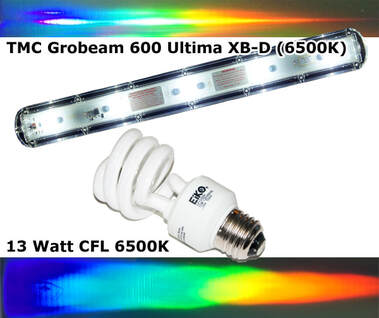
While similar, it is clear to see the LED has bluer and a lower blue NM (fuller blue spectrum) amount as well as more red, less green, and the same yellow.
The point this makes/demonstrates is that while both lights are rated as 6500K, they are still not the same in their light energy output. Even among LED lights we can have differences of spectrographs depending upon emitters used. Think about how mixing all paint colors will produce black, while the mixing of all light energy produces white. We as humans may notice this to some degree, however we do not have the ability to pick out particular colors such as a honeybee can. As well, photosynthetic aquatic life also has differing abilities to pick out the needed light energy for life processes and even though the PAR readings may be equal, the light energy that provides this overall PAR or kelvin "color" is NOT.
A Couple more points to better explain the concepts of PUR, "Useful Light Energy", or "Quality of light per application": I have noted, a dozen "hardware store" warm & cool white, fluorescent lights can provide adequate lighting for a planted aquarium and even basic reefs. However, it would only take a few optimum kelvin T5 lights to accomplish this same task.
The point is, even a T12 cool or warm white provides some useful light energy, but it requires a higher number of these lights (& input energy) to provide adequate light in both quantity and quality for our application of plant or reef aquariums.
One could use nothing but mid-range PAR green emitters, versus using an emitter such as the Osram Oslon NP Blue with the same input wattage and actually obtain a higher PAR, YET the Green emitters are as much as 80% less efficient than blue emitters as references cited previously prove!!!
For further reading about PUR: PUR vs PAR in Aquarium Lighting:
• Why PUR is Important
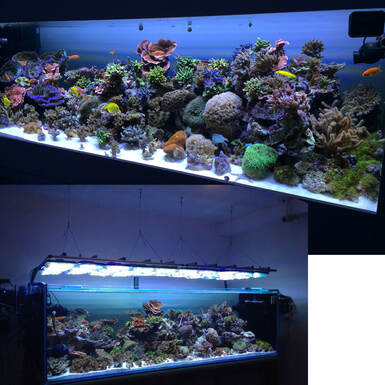
Below is a picture of a Reef Aquarium (88 x 32 x 24”) that includes Acropora corals lighted with ONLY VERY high PUR but lower wattage AAP AquaRay NP 1500 & 2000 LED lights (this tank has been running with these lights for 6 months at the time of the picture).
The point this makes/demonstrates is that while both lights are rated as 6500K, they are still not the same in their light energy output. Even among LED lights we can have differences of spectrographs depending upon emitters used. Think about how mixing all paint colors will produce black, while the mixing of all light energy produces white. We as humans may notice this to some degree, however we do not have the ability to pick out particular colors such as a honeybee can. As well, photosynthetic aquatic life also has differing abilities to pick out the needed light energy for life processes and even though the PAR readings may be equal, the light energy that provides this overall PAR or kelvin "color" is NOT.
A Couple more points to better explain the concepts of PUR, "Useful Light Energy", or "Quality of light per application": I have noted, a dozen "hardware store" warm & cool white, fluorescent lights can provide adequate lighting for a planted aquarium and even basic reefs. However, it would only take a few optimum kelvin T5 lights to accomplish this same task.
The point is, even a T12 cool or warm white provides some useful light energy, but it requires a higher number of these lights (& input energy) to provide adequate light in both quantity and quality for our application of plant or reef aquariums.
One could use nothing but mid-range PAR green emitters, versus using an emitter such as the Osram Oslon NP Blue with the same input wattage and actually obtain a higher PAR, YET the Green emitters are as much as 80% less efficient than blue emitters as references cited previously prove!!!
For further reading about PUR: PUR vs PAR in Aquarium Lighting:
• Why PUR is Important
Below is a picture of a Reef Aquarium (88 x 32 x 24”) that includes Acropora corals lighted with ONLY VERY high PUR but lower wattage AAP AquaRay NP 1500 & 2000 LED lights (this tank has been running with these lights for 6 months at the time of the picture).
Photoinhibition
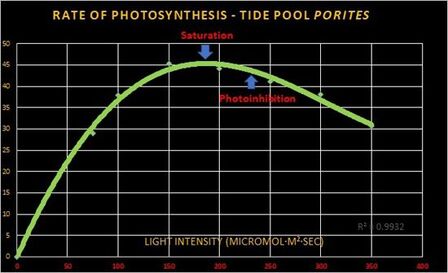
This is another concept to consider that we do not know all the "mechanisms" that drive it. Basically, photoinhibition is the damage to the light harvesting reactions of the photosynthetic capacity of a vascular plant, algae, or cyanobacterium by excess light energy trapped by the chloroplast. This process can occur in in all organisms capable of oxygenic photosynthesis. In both plants & cyanobacteria, blue light causes photoinhibition more efficiently than other wavelengths of visible light, although it has been demonstrated the red light can cause photoinhibition as well.
One of the implications for us as aquarium keepers is this process can often be the result of new light systems until our plants, photosynthetic corals, etc. adapt to the new light.
The other implication is while we may still see good growth of our plants or coral, we often are "over driving" light to where not only are you wasting input energy for unnecessary PAR number the growth is not as good as it could be. This is common now with many popular well marketed LEDS such as the SB Reef Light.
This graph demonstrates maximum photosynthesis in the zooxanthellae in this Porites stony coral was achieved at about 200 µmol·m²·sec. At 350 µmol·m²·sec the rate of photosynthesis was about that seen at 75 µmol·m²·sec!
Further Reference:
• The Myth of Corals Requiring Unlimited Amounts of Light
One of the implications for us as aquarium keepers is this process can often be the result of new light systems until our plants, photosynthetic corals, etc. adapt to the new light.
The other implication is while we may still see good growth of our plants or coral, we often are "over driving" light to where not only are you wasting input energy for unnecessary PAR number the growth is not as good as it could be. This is common now with many popular well marketed LEDS such as the SB Reef Light.
This graph demonstrates maximum photosynthesis in the zooxanthellae in this Porites stony coral was achieved at about 200 µmol·m²·sec. At 350 µmol·m²·sec the rate of photosynthesis was about that seen at 75 µmol·m²·sec!
Further Reference:
• The Myth of Corals Requiring Unlimited Amounts of Light
Lumens
The international unit of luminous flux or quantity of light used as a measure of the total amount of visible light emitted. The higher the lumens, the "brighter" or more "intense" the light looks to the human eye. You can figure lumens per watt by dividing the lumens your lamp lists by the wattage the fixture lists.
Knowing your lumens per watt is just one more small piece of the "aquarium lighting puzzle". For example, a T12 light that is rated at 20 watts with a total lumen output of 800 lumens has a lumen per watt output of 40. While a 13-watt T2 bulb rated at 950 lumens has a lumen output of 73 lumens per watt. This is a clear example that the watts per gallon rule is severely flawed, as the 13-watt T2 (or two of these) is clearly the better choice for a 15-gallon planted aquarium and this does not even take into consideration the PAR/PUR which is also important for plants/corals.
Focused Lumens: It is also noteworthy that even the lumen output can be deceiving when considering aquarium lights. The best LED Lights are a good example of this as these newer technology lights have extremely focused light energy with little essential light energy lost (such as by Restrike), unlike almost every other type of aquarium light currently available. With this focused energy a "high end" LED often requires half the lumens (or often even less) to provide essential light energy to plants, corals, etc. The newer generation LED lights have considerably less loss of lumens at 20 inches than a CFL light (as per tests that show 166% more lumens for the same wattage LED as compared to a common CFL of equal wattage).
Caution as to using Lumens as a useful measurement of Light Output: While lumens are a important useful measurement for standard household light bulb comparison, it is only a part of the equation for aquarium use, especially when this measurement is applied to new technology lights employed by aquarium keepers (such as LEDs). As an example of just one aspect where the lumen measurement falls short is when Kelvin is considered; a cool white lamp emitting 1000 lumens at a color temperature of 5,500K will not emit as much PUR as a lamp emitting 1000 lumens at 6,500K. Moreover, when compared to "Useful Light Energy" (PUR), Lumen output falls well short as useful comparison of light output. This said, I am not saying Lumen output and focused lumens are useless, as these parameters are a piece of the light parameter "pie", but often it is overrated, and these parameters should only be taken as a part and a small part at that when compared to PAR & PUR.
Knowing your lumens per watt is just one more small piece of the "aquarium lighting puzzle". For example, a T12 light that is rated at 20 watts with a total lumen output of 800 lumens has a lumen per watt output of 40. While a 13-watt T2 bulb rated at 950 lumens has a lumen output of 73 lumens per watt. This is a clear example that the watts per gallon rule is severely flawed, as the 13-watt T2 (or two of these) is clearly the better choice for a 15-gallon planted aquarium and this does not even take into consideration the PAR/PUR which is also important for plants/corals.
Focused Lumens: It is also noteworthy that even the lumen output can be deceiving when considering aquarium lights. The best LED Lights are a good example of this as these newer technology lights have extremely focused light energy with little essential light energy lost (such as by Restrike), unlike almost every other type of aquarium light currently available. With this focused energy a "high end" LED often requires half the lumens (or often even less) to provide essential light energy to plants, corals, etc. The newer generation LED lights have considerably less loss of lumens at 20 inches than a CFL light (as per tests that show 166% more lumens for the same wattage LED as compared to a common CFL of equal wattage).
Caution as to using Lumens as a useful measurement of Light Output: While lumens are a important useful measurement for standard household light bulb comparison, it is only a part of the equation for aquarium use, especially when this measurement is applied to new technology lights employed by aquarium keepers (such as LEDs). As an example of just one aspect where the lumen measurement falls short is when Kelvin is considered; a cool white lamp emitting 1000 lumens at a color temperature of 5,500K will not emit as much PUR as a lamp emitting 1000 lumens at 6,500K. Moreover, when compared to "Useful Light Energy" (PUR), Lumen output falls well short as useful comparison of light output. This said, I am not saying Lumen output and focused lumens are useless, as these parameters are a piece of the light parameter "pie", but often it is overrated, and these parameters should only be taken as a part and a small part at that when compared to PAR & PUR.
Watts
Watts equal one joule of energy per second. For us, it's a measurement of how much energy our light fixture is using NOT OF LIGHT OUTPUT! This is why the old rule: "3-5 watts per gallon" can be deceiving, and this rule is only a starting point at best of late. This archaic rule was more accurate when all that was used were T12/T8 lamps which is what this rule is based on. Keeping this in mind the average T12 has a lumens per watt rating of 40, which means you would need half as many watts of a bulb that produces 80 lumens per watt (assuming PUR & other aspects are equal).
The term "watts per gallon" is getting more archaic with the newer T-5, CFL, the SHO, & especially the new reef compatible LED lights.
Even within LED Lights, one 30-watt LED is not equal to another 30-watt LED. An example, you cannot compare a 30 Watt AAP/TMC Reef White to a 130-watt EcoTech Radion. However, if you were to use an equal wattage of the TMC Ocean Blue or Reef White, you would have more actual useful light energy (PUR) with these per watt of energy used (input energy) than the EcoTech (this is not to say the EcoTech Radion isn't reef capable LED). More importantly, when you measure input wattage per output of mmol of PAR (which both are easily measurable), you can quickly discern that the Reef White is considerably more efficient. Please read the FULL article to understand why I made this statement.
Expanding a bit more, wattage input of lights versus PAR/PUR output is where the actual watts used when comparing one light to another is simply not at all accurate. Keep in mind that PUR has nothing to do with input wattage. Moreover, PAR efficiency can vary due to PUR, fan use (fans waste input energy/watts), lenses, re-strike (in fluorescent lights in particular), and circuitry (such as daisy chaining of emitters common to many discount LEDs).
For example: The Fluval, Finnex, SB Reef, & Current Satellite are all Chinese made LEDs that often daisy chain their often plethora of emitters versus LEDs which use PWM, optimized PUR, and advanced circuitry/drivers with a lower number of HO quality emitters. The result is a much higher wattage input per PAR output which the numbers speak for themselves as to the much lower light efficiency (sorry, math trumps marketing). An example is the SB Reef Light PRO 32. This is rated at 363 watts input energy with a PAR of approximately 881 (100%) at 400mm of air. This comes to .41 watts of input energy per 1 PAR. Another example would be the Fluval Fresh & Plant 2.0 A3990 which uses 32 watts of input energy with a PAR output about 70 mmol at 400mm. This is .45 watt of input energy per mm of PAR compared to an AquRay NP 2000 at only .08 watt of input energy per point of PAR.
The term "watts per gallon" is getting more archaic with the newer T-5, CFL, the SHO, & especially the new reef compatible LED lights.
Even within LED Lights, one 30-watt LED is not equal to another 30-watt LED. An example, you cannot compare a 30 Watt AAP/TMC Reef White to a 130-watt EcoTech Radion. However, if you were to use an equal wattage of the TMC Ocean Blue or Reef White, you would have more actual useful light energy (PUR) with these per watt of energy used (input energy) than the EcoTech (this is not to say the EcoTech Radion isn't reef capable LED). More importantly, when you measure input wattage per output of mmol of PAR (which both are easily measurable), you can quickly discern that the Reef White is considerably more efficient. Please read the FULL article to understand why I made this statement.
Expanding a bit more, wattage input of lights versus PAR/PUR output is where the actual watts used when comparing one light to another is simply not at all accurate. Keep in mind that PUR has nothing to do with input wattage. Moreover, PAR efficiency can vary due to PUR, fan use (fans waste input energy/watts), lenses, re-strike (in fluorescent lights in particular), and circuitry (such as daisy chaining of emitters common to many discount LEDs).
For example: The Fluval, Finnex, SB Reef, & Current Satellite are all Chinese made LEDs that often daisy chain their often plethora of emitters versus LEDs which use PWM, optimized PUR, and advanced circuitry/drivers with a lower number of HO quality emitters. The result is a much higher wattage input per PAR output which the numbers speak for themselves as to the much lower light efficiency (sorry, math trumps marketing). An example is the SB Reef Light PRO 32. This is rated at 363 watts input energy with a PAR of approximately 881 (100%) at 400mm of air. This comes to .41 watts of input energy per 1 PAR. Another example would be the Fluval Fresh & Plant 2.0 A3990 which uses 32 watts of input energy with a PAR output about 70 mmol at 400mm. This is .45 watt of input energy per mm of PAR compared to an AquRay NP 2000 at only .08 watt of input energy per point of PAR.
CRI

To help indicate how colors will appear under different light sources, a system was devised some years ago that mathematically compares how a light source shifts the location of eight specified pastel colors on a version of the C.I.E. color space as compared to the same colors lighted by a reference source of the same Color Temperature. If there is no change in appearance, the source in question is given a CRI of 100 by definition. From 2000K to 5000K, the reference source is the Black Body Radiator and above 5000K, it is an agreed upon form of daylight.
A CRI of 100 has a heavy red spectrum. The color temperature is 2700 K for incandescent light and 3000 K for halogen light. An incandescent lamp, virtually by definition, has a Color Rendering Index (CRI) close to 100. This does not mean that an incandescent lamp is a perfect color rendering light source. It is not. It is very weak in blue, as anyone who has tried to sort out navy blues, royal blues, & black under low levels of incandescent lighting.
Interestingly (& sadly), many lower end aquarium LED lights are matching their lights to CRI ratings. The result is a brighter light that looks good to us, often brings out colors to our human eyes, but are actually much less efficient for plant & especially coral growth. Two popular offenders are the Finnex & Fluval. Common sense should tell one that the tropical noon time sun is 6500 kelvins, and this is the optimum light for plant growth, not what looks best and brightest to us!!!
Reference:
• Specifying Light & Color
CRI is useful in specifying color if it is used within its limitations. Colors viewed under sources with line spectra such as mercury, GE Multi-Vapor® metal halide or Lucalox® high pressure sodium lamps, may actually look better than their CRI would indicate. However, some exotic fluorescent lamp colors may have very high CRI's, while substantially distorting some particular object color.
The pictures above are a good example of marketing using CRI whereby the picture on the right uses a halogen bulb source touted as having a "spectral match to daylight" and a CRI of 98. HOWEVER, the daylight picture to the left with the lower CRI is actually more accurate showing her hat as white instead of an off yellow which is typical of the lower kelvin lights also employed by lower end aquarium light manufacturers that tout high CRI.
To be blunt, CRI is NOT a parameter that is important in determining the best aquarium light, but it is included here since many mistakenly tend to consider it an important parameter, in fact most lights sold with CRI ratings prominently displayed are intended for home or industrial use, NOT aquariums! However, many low-end aquarium lights such as the Fluval LED Lights still refer to CRI since their PAR & in particular, PUR is poor.
A CRI of 100 has a heavy red spectrum. The color temperature is 2700 K for incandescent light and 3000 K for halogen light. An incandescent lamp, virtually by definition, has a Color Rendering Index (CRI) close to 100. This does not mean that an incandescent lamp is a perfect color rendering light source. It is not. It is very weak in blue, as anyone who has tried to sort out navy blues, royal blues, & black under low levels of incandescent lighting.
Interestingly (& sadly), many lower end aquarium LED lights are matching their lights to CRI ratings. The result is a brighter light that looks good to us, often brings out colors to our human eyes, but are actually much less efficient for plant & especially coral growth. Two popular offenders are the Finnex & Fluval. Common sense should tell one that the tropical noon time sun is 6500 kelvins, and this is the optimum light for plant growth, not what looks best and brightest to us!!!
Reference:
• Specifying Light & Color
CRI is useful in specifying color if it is used within its limitations. Colors viewed under sources with line spectra such as mercury, GE Multi-Vapor® metal halide or Lucalox® high pressure sodium lamps, may actually look better than their CRI would indicate. However, some exotic fluorescent lamp colors may have very high CRI's, while substantially distorting some particular object color.
The pictures above are a good example of marketing using CRI whereby the picture on the right uses a halogen bulb source touted as having a "spectral match to daylight" and a CRI of 98. HOWEVER, the daylight picture to the left with the lower CRI is actually more accurate showing her hat as white instead of an off yellow which is typical of the lower kelvin lights also employed by lower end aquarium light manufacturers that tout high CRI.
To be blunt, CRI is NOT a parameter that is important in determining the best aquarium light, but it is included here since many mistakenly tend to consider it an important parameter, in fact most lights sold with CRI ratings prominently displayed are intended for home or industrial use, NOT aquariums! However, many low-end aquarium lights such as the Fluval LED Lights still refer to CRI since their PAR & in particular, PUR is poor.
Aquarium Bulb Type
Aquarium Light Types Explained Here Include:
• T8 & T12, • T5, • T2, • VHO, • CFL, • SHO, • Metal Halide, • LED, • Lunar, • Induction, • HID Xenon
• T-12: A standard pin, 1-1/2" wide bulb. The main caution to the use of these bulbs for aquariums, is the use of shop lights as an inexpensive alternative to many aquarium lights. A 4100 K cool white shop light is not going to come close to a 6400 K daylight lamp that is of peak PAR efficiency (even if you match lumens). This bulb will generally use more watts and have a lower lumens per watt ratio (usually around 40) and is common in shop lights and even some aquarium bulbs. These are generally the least expensive lamps to purchase and even though they may be "old school", some still try to make up for the low technology with the fact you can purchase several for a low price to make up for poor efficiency.
• T-8: A standard pin, 1" wide bulb. As compared to the T-12, a 48" T-12 will use 40 watts, while a 48" T-8 will often use 32 watts (although not always), making the T-8 a more efficient lamp than the T-12. The T-8 is the more common bulb/lamp size in many basic aquarium lights.
• T-5: Generally, around 13 mm in diameter. This is a mini pin bulb which generally uses even less watts per lumen than many than T-8 bulbs. T-5 lamps range from 65 to 105 lumens per watt. The T5 became very popular in the early 2000s among both plant keeping freshwater aquarists and reef keepers for good reasons; they are compact, come in MANY varieties and high lumen per watt outputs (as a broad generalization only requiring 2 to 4 watts per gallon for shallower planted/reef applications depending upon tank depth and other factors). While the T2 was the latest in straight tube fluorescent lights, the T5 still is better suited for aquariums over 20 inches in depth. The T-5 also comes in many more different varieties, sizes, and even "qualities" (such as the premium Giesemann), and thus is the preferred option for most.
• One negative with T5s is that the quality control on these lighting fixtures (not the bulbs themselves) is often lacking. This problem tends to be with some of the HO T5 light ballasts/fixtures, and in fact tends to be a problem with VHO Compact Light Fixtures as well. For this reason my recommendation is to avoid the VHO or HO T5 or Power Compact CFLs and stick with the standard output versions. If higher output is needed consider more standard T5 lights or the newer technology HO LED lights instead such as the AquaRay line (the cheap LEDs such as the Finnex are NOT an option to a T5 lamp). In fact when cost per lumen as per lifespan is considered, a LED Aquarium Light Fixtureis now a much better deal (since LEDs can last 50,000 hours vs. the common 8000 lifespan of a HO T5 or VHO Power Compact).
Another consideration for higher output requirements, especially hexagon planted freshwater aquariums, consider the SHO light over the T5.
As a final point, while the T5 is a good to excellent light (if not the best fluorescent light in many aspects), it is often pushed by some aquarium keepers that are not aware that there is also newer technology lights LED. This said, there are many professionals that still recommend and use the T5 for both reef and high light requiring planted aquariums for a variety of reasons such as the sleek design, and wider output than some LED lights (as well as build quality compared to many cheap LEDs).
Since I have seen a wide variance in quality of build as well as quality of output similar to with LED lights, I recommend going with the best and for this I would recommend the premium Giesemann T5 lights which have unique phosphor blends that are characterized by exceptionally high output performance, long life span, consistent coloration combined with high levels of spectral stability over time. In other words both quantity (PAR) and quality (PUR) of light.
Reference:
• T5 - Still a popular technology
• T8 & T12, • T5, • T2, • VHO, • CFL, • SHO, • Metal Halide, • LED, • Lunar, • Induction, • HID Xenon
• T-12: A standard pin, 1-1/2" wide bulb. The main caution to the use of these bulbs for aquariums, is the use of shop lights as an inexpensive alternative to many aquarium lights. A 4100 K cool white shop light is not going to come close to a 6400 K daylight lamp that is of peak PAR efficiency (even if you match lumens). This bulb will generally use more watts and have a lower lumens per watt ratio (usually around 40) and is common in shop lights and even some aquarium bulbs. These are generally the least expensive lamps to purchase and even though they may be "old school", some still try to make up for the low technology with the fact you can purchase several for a low price to make up for poor efficiency.
• T-8: A standard pin, 1" wide bulb. As compared to the T-12, a 48" T-12 will use 40 watts, while a 48" T-8 will often use 32 watts (although not always), making the T-8 a more efficient lamp than the T-12. The T-8 is the more common bulb/lamp size in many basic aquarium lights.
• T-5: Generally, around 13 mm in diameter. This is a mini pin bulb which generally uses even less watts per lumen than many than T-8 bulbs. T-5 lamps range from 65 to 105 lumens per watt. The T5 became very popular in the early 2000s among both plant keeping freshwater aquarists and reef keepers for good reasons; they are compact, come in MANY varieties and high lumen per watt outputs (as a broad generalization only requiring 2 to 4 watts per gallon for shallower planted/reef applications depending upon tank depth and other factors). While the T2 was the latest in straight tube fluorescent lights, the T5 still is better suited for aquariums over 20 inches in depth. The T-5 also comes in many more different varieties, sizes, and even "qualities" (such as the premium Giesemann), and thus is the preferred option for most.
• One negative with T5s is that the quality control on these lighting fixtures (not the bulbs themselves) is often lacking. This problem tends to be with some of the HO T5 light ballasts/fixtures, and in fact tends to be a problem with VHO Compact Light Fixtures as well. For this reason my recommendation is to avoid the VHO or HO T5 or Power Compact CFLs and stick with the standard output versions. If higher output is needed consider more standard T5 lights or the newer technology HO LED lights instead such as the AquaRay line (the cheap LEDs such as the Finnex are NOT an option to a T5 lamp). In fact when cost per lumen as per lifespan is considered, a LED Aquarium Light Fixtureis now a much better deal (since LEDs can last 50,000 hours vs. the common 8000 lifespan of a HO T5 or VHO Power Compact).
Another consideration for higher output requirements, especially hexagon planted freshwater aquariums, consider the SHO light over the T5.
As a final point, while the T5 is a good to excellent light (if not the best fluorescent light in many aspects), it is often pushed by some aquarium keepers that are not aware that there is also newer technology lights LED. This said, there are many professionals that still recommend and use the T5 for both reef and high light requiring planted aquariums for a variety of reasons such as the sleek design, and wider output than some LED lights (as well as build quality compared to many cheap LEDs).
Since I have seen a wide variance in quality of build as well as quality of output similar to with LED lights, I recommend going with the best and for this I would recommend the premium Giesemann T5 lights which have unique phosphor blends that are characterized by exceptionally high output performance, long life span, consistent coloration combined with high levels of spectral stability over time. In other words both quantity (PAR) and quality (PUR) of light.
Reference:
• T5 - Still a popular technology
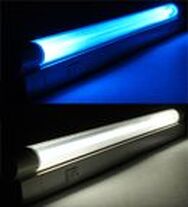
• T-2: The T2 lights measure only 7 mm and allow for several bulbs in a small space. A 13-watt 20-inch T-2 Bulb (6400 K) produces 950 lumens which is 73 lumens per watt in a very small space with low wasted green/yellow light energy that is often found in other Power Compact Lights!
As little as 1 watts per gallon (low light) to 1.75 watts per gallo0n (high light) for a planted aquarium is all that is needed from these T2 Lights! (Depending upon tank depth, and not for tanks over 18 inches max: Consider SHO for tanks over 18 inche0s).
As little as 1 watts per gallon (low light) to 1.75 watts per gallo0n (high light) for a planted aquarium is all that is needed from these T2 Lights! (Depending upon tank depth, and not for tanks over 18 inches max: Consider SHO for tanks over 18 inche0s).
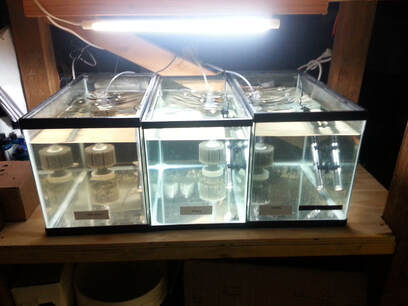
These T2 lamps and fixtures are about the best fluorescent lamps in a small space I have seen! These are very useful for small to medium planted aquariums or Nano Reefs or even shelves for betta breeders (although ONLY as a compliment in larger aquariums over 20 inches in DEPTH for freshwater and 16 inches for marine). The picture above displays the remarkable amount of light these fixtures put out for little energy usage. These aquariums are well lit by ONE SINGLE 13-Watt T2 light fixture!
The linkable fixture feature is also a nice aspect of these T2 lights/fixtures (this allows for use in larger aquaria such as 60 gallons). Some T2s can be linked with small extensions which are available with these T2 fixtures. These allow you the choice of either placing a T2 in series (end to end) or in parallel (which is useful if you desire a higher output yet in a small space or to utilize a daylight and blue/actinic light parallel to each other) with out having to add multiple outlets/plugs.
The linkable fixture feature is also a nice aspect of these T2 lights/fixtures (this allows for use in larger aquaria such as 60 gallons). Some T2s can be linked with small extensions which are available with these T2 fixtures. These allow you the choice of either placing a T2 in series (end to end) or in parallel (which is useful if you desire a higher output yet in a small space or to utilize a daylight and blue/actinic light parallel to each other) with out having to add multiple outlets/plugs.
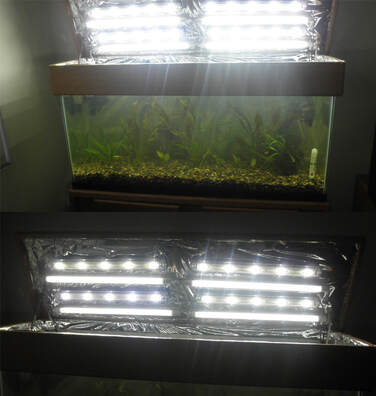
The newest generation T2 Lights require less watts to provide the same useful light energy (in particular required by plants & coral) than all other lights except for LED. Speaking of LED Lights, the T2 made an excellent complement to LED Lights (for cost savings as well). The picture above displays a newly set up planted freshwater tank that has 4 2nd generation AAP GroBeam 500 LED and 4 6400K T2s as well as a Mylar Reflector (The Aquarium above is a planted 10 gallon with two 11-Watt T2 fixtures).
When all important parameters are considered (PAR, useful energy, lumens per watt, etc.) a typical 6400K T2 about 40% of the wattage of a standard T8/T12 aquarium light for the same useful output (a 13-watt T2 will equal 30 watts of most older fluorescent aquarium lights).
In fact, these lamps were even a good choice for many aquariums such as 60 gallons and larger since each fixture can be linked together forming a larger fixture. For instance, I have used two T2s linked together for some 60-gallon FW aquarium and two sets of two (placed in parallel in the hood) for planted 60-gallon FW aquariums. T2 Fixtures/lights also work well in Marine Aquariums (particularly pico/nano reef & Refugiums) since these lamps in the 6400 K version have a high output in PAR required for symbiotic algae that live within corals.
Reference:
• Freshwater Planted Aquariums
One negative with the first generation T2 as compared to the older T5 is that there are not the selection/variety, however as noted in the previous paragraph, blue/actinic T2 lights are now available to the hobby. As well, there is not as much need for some of the versatility other lights have, as the T2 has its own versatility such as small space combined with higher lumen per watt output.
Unfortunately, the plethora of cheap LEDs that have flooded the market (mostly from China) have pretty much killed the T2 light, despite the fact that often the T2 could out perform many of the lower end LEDs commonly sold when measured in input energy to output energy & results.
When all important parameters are considered (PAR, useful energy, lumens per watt, etc.) a typical 6400K T2 about 40% of the wattage of a standard T8/T12 aquarium light for the same useful output (a 13-watt T2 will equal 30 watts of most older fluorescent aquarium lights).
In fact, these lamps were even a good choice for many aquariums such as 60 gallons and larger since each fixture can be linked together forming a larger fixture. For instance, I have used two T2s linked together for some 60-gallon FW aquarium and two sets of two (placed in parallel in the hood) for planted 60-gallon FW aquariums. T2 Fixtures/lights also work well in Marine Aquariums (particularly pico/nano reef & Refugiums) since these lamps in the 6400 K version have a high output in PAR required for symbiotic algae that live within corals.
Reference:
• Freshwater Planted Aquariums
One negative with the first generation T2 as compared to the older T5 is that there are not the selection/variety, however as noted in the previous paragraph, blue/actinic T2 lights are now available to the hobby. As well, there is not as much need for some of the versatility other lights have, as the T2 has its own versatility such as small space combined with higher lumen per watt output.
Unfortunately, the plethora of cheap LEDs that have flooded the market (mostly from China) have pretty much killed the T2 light, despite the fact that often the T2 could out perform many of the lower end LEDs commonly sold when measured in input energy to output energy & results.
VHO Power Compact
This stands for "Very High Output". These come in T-5 thru T-12 standard fluorescent tubes and in the newer power compact (usually 4 pin T6) lamps such as the Current USA, Coralife Quad & Via Aqua Helios VHO.
The Helios & other VHO Power Compact Fixtures come/came in a variety of sizes with outputs up to 180 watts out of lamps under 40 inches in length, which rival many T5. These higher output VHO fixtures/lamps have higher Kelvin and wattage output than previous generation VHO lamps/fixtures of similar size. Coralife has a quad lamp VHO (such as the 20-inch; 96-watt fixture) that have high output in small space.
However, both these before mentioned lighting systems are a bit pricey in my opinion for the "light output" for the price paid. As well the electronic ballasts contained in not just these, but ALL these VHO styles of CFL light fixtures (Current USA, JBJ, etc.) tend to have a short life span of under 3-5 years in my experience. When the ballasts go out, generally the replacement cost is the same as a new fixture.
I should also note that as of my latest update of this section (VHO), I have found their durability in relation to cost, and output in essential lighting parameters is not as good as T5, SHO, or especially premium LED Lights, which the LED in my tests, feedback, research and experience are the future of aquarium lighting, especially as it pertains to freshwater plant and reef aquariums.
Product Resources:
• SHO Lights, Lighting
• Premium Aquarium LED Lighting
The Helios & other VHO Power Compact Fixtures come/came in a variety of sizes with outputs up to 180 watts out of lamps under 40 inches in length, which rival many T5. These higher output VHO fixtures/lamps have higher Kelvin and wattage output than previous generation VHO lamps/fixtures of similar size. Coralife has a quad lamp VHO (such as the 20-inch; 96-watt fixture) that have high output in small space.
However, both these before mentioned lighting systems are a bit pricey in my opinion for the "light output" for the price paid. As well the electronic ballasts contained in not just these, but ALL these VHO styles of CFL light fixtures (Current USA, JBJ, etc.) tend to have a short life span of under 3-5 years in my experience. When the ballasts go out, generally the replacement cost is the same as a new fixture.
I should also note that as of my latest update of this section (VHO), I have found their durability in relation to cost, and output in essential lighting parameters is not as good as T5, SHO, or especially premium LED Lights, which the LED in my tests, feedback, research and experience are the future of aquarium lighting, especially as it pertains to freshwater plant and reef aquariums.
Product Resources:
• SHO Lights, Lighting
• Premium Aquarium LED Lighting
PC or CFL
This stands for "Power Compact" or "Compact Fluorescent Lamp (light)". These bulbs come in straight pin arrangements, square pin arrangements, and the self-ballasted standard incandescent fixture "screw in" type. These bulbs are similar to T-5s and have about the same lumen per watt output (generally around 60-70 lumens per watt).
The standard medium base version of these lamps will fit in a common incandescent light fixture, making these lights about the most economical lights you can purchase with this kind of output. These are an excellent choice for use in low to medium light planted freshwater aquariums too.
See:
• Compact Fluorescent light bulbs, standard screw in base
These self-ballasted high PAR lamps are inexpensive and make it easy for even an aquarist on a budget (even a freshwater fish only tank) to provide the best possible lighting within a budget!
The standard medium base version of these lamps will fit in a common incandescent light fixture, making these lights about the most economical lights you can purchase with this kind of output. These are an excellent choice for use in low to medium light planted freshwater aquariums too.
See:
• Compact Fluorescent light bulbs, standard screw in base
These self-ballasted high PAR lamps are inexpensive and make it easy for even an aquarist on a budget (even a freshwater fish only tank) to provide the best possible lighting within a budget!
SHO Power Compact Lights
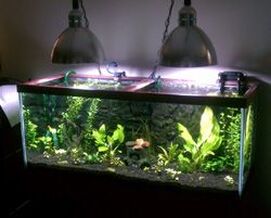
|
|
This "power compact on steroids" is another option for planted aquariums or hydroponics. In fact, this is option better option than many of the cheap LEDs flooding the market such as the Finnex or Satellite when up-front costs per light efficiency is considered (as well as durability). When used with the optional polished reflector or in an aquarium canopy with a mylar or similar reflector, the SHO is an option still worth considering.
The SHO Light is currently sold in a self-ballasted PC bulbs/light. The 105-Watt SHO Daylight bulb puts out 6300 lumens and is comparable to a 525-watt Standard bulb (click on the pictures for links). This comes out to 60 lumens per watt; however, this is a deceptive guide, as you can fit many more of these bulbs in a given space and also utilize more efficient reflectors.
Product Resource:
• SHO & CFL Lights for Aquariums, Hydroponics
The SHO is already popular with Green Houses/hydroponics/cannabis growers and has a loyal repeat buyer following for planted aquariums. In fact, the 105 Watt SHOs were in short supply during each Winter is due to companies purchasing 1000 of these for lighting greenhouses & hospitals.
My point is: If a company (greenhouse business) that needs the correct lighting that are price effective to grow plants for a business, all the more reason these should be considered in many freshwater plant aquarium applications.
In fact, the medical community is now utilizing these SHO bulbs (& similar full spectrum lights, which is also often making the SHO in short supply) due to increasing studies that show better immune function, mental health, and more. Similar animal studies show like results. I learned of this when inquiring as to why the SHO lights were currently unavailable from the North American distributor, and they pointed out that several hospitals and convalescent homes had purchased over 1500 of these lights. They pointed out the simplicity of these Super High Output bulbs are quickly making these a favorite of the medical community for their full spectrum light needs (I now use a few 65-Watt 6400K SHOs in my home after learning this and there is certainly a difference).
There are few drawbacks to the SHO light for aquarium use: One such drawback is that in any "tube light" some of the light that shines up from each tube just reflects right back into the tube and is lost (this is called "Restrike"). HOWEVER, the spiral design & especially the use of an optional reflector tends to limit this minor problem and based on extreme plant growth achieved this is obviously not as much a factor as some may claim (this is essentially a problem with ALL compact fluorescent lights). As well, while the SHO does not produce nearly as much heat as a Metal Halide, the simple fact of the wattage used by these lights still produces heat, so a well vented hood or the use of a reflector is advised (any light should be placed in a ventilated hood/canopy as trapped moisture can quickly damage any light whether an SHO, T5 or LED). Finally, the only other potential negative is that these SHO lights are more of a DIY lighting application, not an out of the box and place on your aquarium light applications as with many T5 & LEDs; so those who do not have DIY abilities, time, or simply desire an out of the box light might find this is not the light for them.
Back to the positives of Super High Output lights: The cost per output of these lights is a major attribute of the SHO. This is especially true for planted freshwater aquariums when cost is considered since these lamps do not require expensive ballasts (SHO are self-ballasted) and generally cost $30 and up per lamp. Each time you change the lamp, which should be just as often as any other fluorescent light such as the T5, you get a fresh ballast, so replacement ballasts costs ARE ZERO which in fact DO HAPPEN with T5 and other fluorescents!!!
See also:
• Aquarium Plant Care, Information
Since the 6400K SHO requires as little as 2 to 2.5 watts per gallon for the most light demanding plants; Four 85-watt SHOs (or 105 watts for even higher output) can easily handle a 6-foot FW 125-gallon planted aquarium (some T2 or T5 can fill in some more dim spots if necessary).
The SHO Light is currently sold in a self-ballasted PC bulbs/light. The 105-Watt SHO Daylight bulb puts out 6300 lumens and is comparable to a 525-watt Standard bulb (click on the pictures for links). This comes out to 60 lumens per watt; however, this is a deceptive guide, as you can fit many more of these bulbs in a given space and also utilize more efficient reflectors.
Product Resource:
• SHO & CFL Lights for Aquariums, Hydroponics
The SHO is already popular with Green Houses/hydroponics/cannabis growers and has a loyal repeat buyer following for planted aquariums. In fact, the 105 Watt SHOs were in short supply during each Winter is due to companies purchasing 1000 of these for lighting greenhouses & hospitals.
My point is: If a company (greenhouse business) that needs the correct lighting that are price effective to grow plants for a business, all the more reason these should be considered in many freshwater plant aquarium applications.
In fact, the medical community is now utilizing these SHO bulbs (& similar full spectrum lights, which is also often making the SHO in short supply) due to increasing studies that show better immune function, mental health, and more. Similar animal studies show like results. I learned of this when inquiring as to why the SHO lights were currently unavailable from the North American distributor, and they pointed out that several hospitals and convalescent homes had purchased over 1500 of these lights. They pointed out the simplicity of these Super High Output bulbs are quickly making these a favorite of the medical community for their full spectrum light needs (I now use a few 65-Watt 6400K SHOs in my home after learning this and there is certainly a difference).
There are few drawbacks to the SHO light for aquarium use: One such drawback is that in any "tube light" some of the light that shines up from each tube just reflects right back into the tube and is lost (this is called "Restrike"). HOWEVER, the spiral design & especially the use of an optional reflector tends to limit this minor problem and based on extreme plant growth achieved this is obviously not as much a factor as some may claim (this is essentially a problem with ALL compact fluorescent lights). As well, while the SHO does not produce nearly as much heat as a Metal Halide, the simple fact of the wattage used by these lights still produces heat, so a well vented hood or the use of a reflector is advised (any light should be placed in a ventilated hood/canopy as trapped moisture can quickly damage any light whether an SHO, T5 or LED). Finally, the only other potential negative is that these SHO lights are more of a DIY lighting application, not an out of the box and place on your aquarium light applications as with many T5 & LEDs; so those who do not have DIY abilities, time, or simply desire an out of the box light might find this is not the light for them.
Back to the positives of Super High Output lights: The cost per output of these lights is a major attribute of the SHO. This is especially true for planted freshwater aquariums when cost is considered since these lamps do not require expensive ballasts (SHO are self-ballasted) and generally cost $30 and up per lamp. Each time you change the lamp, which should be just as often as any other fluorescent light such as the T5, you get a fresh ballast, so replacement ballasts costs ARE ZERO which in fact DO HAPPEN with T5 and other fluorescents!!!
See also:
• Aquarium Plant Care, Information
Since the 6400K SHO requires as little as 2 to 2.5 watts per gallon for the most light demanding plants; Four 85-watt SHOs (or 105 watts for even higher output) can easily handle a 6-foot FW 125-gallon planted aquarium (some T2 or T5 can fill in some more dim spots if necessary).
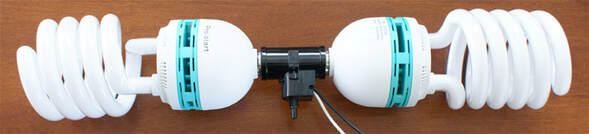
he SHO can be mounted into your hood using a standard incandescent fixture. I recommend using an aluminum foil or better an easily made mylar reflector to amplify light downward (& reflect heat away from the canopy). I also recommend venting the hood to remove heat and moisture (a small outward direction fan can be helpful too).
The SHO light is most effective hung as a pendant light using reflector similar to how Metal Halides are commonly installed over an open aquarium. These SHO lamps are also an excellent compliment to MH, VHO or other "strip" lamps for use in reef tanks (in part due to their high intensity in small space and PAR output which is important for the symbiotic coral/algae relationship). Research (albeit older research now) has shown that many stony corals, clams, and other sessile species that depend on photosynthesis of zooanthellic algae not only thrive but also propagate when maintained under Power Compact lighting alone, and the SHO power compact has a MUCH higher useful light output over standard CFL.
The picture above shows one way of DIY mounting of a SHO light with a reflector by designing your own "rail" system that fits on the aquarium top. Multiple SHO Lights can be added with just such a mounting system. This tank shows just one of many simple ways to install a SHO light which also includes hanging pendent style, or inside of a canopy.
In summary as to SHO lights for aquarium use, what I find amusing is that the only negative comment I have had from someone who actually used an SHO in his 30 Hexagon is that his plants grew TOO FAST with constant pearling and he could not keep up with them due to his work schedule. Honestly this negative is positive proof of these lamps abilities!
The SHO light is most effective hung as a pendant light using reflector similar to how Metal Halides are commonly installed over an open aquarium. These SHO lamps are also an excellent compliment to MH, VHO or other "strip" lamps for use in reef tanks (in part due to their high intensity in small space and PAR output which is important for the symbiotic coral/algae relationship). Research (albeit older research now) has shown that many stony corals, clams, and other sessile species that depend on photosynthesis of zooanthellic algae not only thrive but also propagate when maintained under Power Compact lighting alone, and the SHO power compact has a MUCH higher useful light output over standard CFL.
The picture above shows one way of DIY mounting of a SHO light with a reflector by designing your own "rail" system that fits on the aquarium top. Multiple SHO Lights can be added with just such a mounting system. This tank shows just one of many simple ways to install a SHO light which also includes hanging pendent style, or inside of a canopy.
In summary as to SHO lights for aquarium use, what I find amusing is that the only negative comment I have had from someone who actually used an SHO in his 30 Hexagon is that his plants grew TOO FAST with constant pearling and he could not keep up with them due to his work schedule. Honestly this negative is positive proof of these lamps abilities!
Metal Halide (MH)
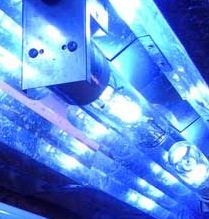
Metal Halide was generally considered the "Kings" of reef aquarium lighting due to depth penetration, output, spectrum, and over all beauty and amount of coral life they help support making most corals "pop" with life (however the newest HO LEDs are now over taking the MH in many aspects of aquarium lighting). Aesthetically speaking the Metal Halide is also hard to beat, however the latest technology LED lights are now beginning to surpass MH for Reefs and LEDs have been proven to surpass MH with plant growth in nursery/hydroponics environments (one study/test shows a 12-Watt Full spectrum LED producing better growth than a 175 Watt MH of the same type!).
That said for tanks over 30 inches in specimen placement, the Metal Halide is still generally the best available light, especially when used in light combinations that include 20,000K, with other popular Metal Halide Kelvin Color Temperatures being 10,000K, and 14,000K. The popular "Radium" 150-Watt 20000K Metal Halide Bulb is still a difficult source of reef lighting to beat by any light, especially for many Acropora corals.
As for other light comparisons to the MH, even the newer T-5 lamps cannot achieve the depth penetration and overall output of these lights. Metal Halides generally have very good lumens per watt ratio (although I have seen a lot of variation and even incorrect ratings here). However, it is safe to say that MH are generally found with lumens to watt ratios of 50 to as high as 90 which is among the highest of any aquarium lights available.
Metal Halide work via a gas mixture of halides and other elements, the actual light production comes from the small bubble of gas that is held in place by metal wires and/or supports. The electricity running between them and the small gas bubble, heats them, similar to an incandescent filament. This is one of the reasons that Metal Halide bulbs give off more heat than other bulbs.
MH Lights are generally sold in two basic types for aquarium use: the Mogul base & the HQI Double Ended Metal Halide bulbs. Mogul base screw in Metal Halide bulbs for Aquarium use come in a variety of color spectrum from 10K to 20K (the bluest) and wattages from 250W - 1000W. German made (Ushio) metal halides have an excellent reputation for producing the best lighting effects for reef aquariums.
The newer Halogen Quartz Iodide (HQI) lighting systems are used mostly on saltwater reef aquariums. HQI bulbs are commonly offered with spectrums of 10,000K and 20,000K. These high-intensity bulbs help corals thrive but give off less heat than regular metal halide bulbs. HQI Double Ended Metal Halide bulbs have been used in Europe for many years have gained popularity in the U.S. among aquarium hobbyists in the last several years. Double Ended MH HQI bulbs offer many of the same features as standard mogul base Metal Halide bulbs but are designed differently. These bulbs are much smaller than mogul base screw in Metal Halides and are double ended. The benefits of using HQI Metal Halide bulbs are that they offer a cleaner color spectrum (useful light energy/responsive wavelength), are more efficient, produce slightly less heat, and last longer than standard Mogul Base metal halide lamps.
The downside is the heat that MH lights produce, often resulting in the need for hood fans and even chillers, although the newer open design units such as the EcoSystems USHIO double end fixture and HQI bulb works well for 10-25 or even larger aquariums when other lights are included in the "mix" without a chiller.
That said for tanks over 30 inches in specimen placement, the Metal Halide is still generally the best available light, especially when used in light combinations that include 20,000K, with other popular Metal Halide Kelvin Color Temperatures being 10,000K, and 14,000K. The popular "Radium" 150-Watt 20000K Metal Halide Bulb is still a difficult source of reef lighting to beat by any light, especially for many Acropora corals.
As for other light comparisons to the MH, even the newer T-5 lamps cannot achieve the depth penetration and overall output of these lights. Metal Halides generally have very good lumens per watt ratio (although I have seen a lot of variation and even incorrect ratings here). However, it is safe to say that MH are generally found with lumens to watt ratios of 50 to as high as 90 which is among the highest of any aquarium lights available.
Metal Halide work via a gas mixture of halides and other elements, the actual light production comes from the small bubble of gas that is held in place by metal wires and/or supports. The electricity running between them and the small gas bubble, heats them, similar to an incandescent filament. This is one of the reasons that Metal Halide bulbs give off more heat than other bulbs.
MH Lights are generally sold in two basic types for aquarium use: the Mogul base & the HQI Double Ended Metal Halide bulbs. Mogul base screw in Metal Halide bulbs for Aquarium use come in a variety of color spectrum from 10K to 20K (the bluest) and wattages from 250W - 1000W. German made (Ushio) metal halides have an excellent reputation for producing the best lighting effects for reef aquariums.
The newer Halogen Quartz Iodide (HQI) lighting systems are used mostly on saltwater reef aquariums. HQI bulbs are commonly offered with spectrums of 10,000K and 20,000K. These high-intensity bulbs help corals thrive but give off less heat than regular metal halide bulbs. HQI Double Ended Metal Halide bulbs have been used in Europe for many years have gained popularity in the U.S. among aquarium hobbyists in the last several years. Double Ended MH HQI bulbs offer many of the same features as standard mogul base Metal Halide bulbs but are designed differently. These bulbs are much smaller than mogul base screw in Metal Halides and are double ended. The benefits of using HQI Metal Halide bulbs are that they offer a cleaner color spectrum (useful light energy/responsive wavelength), are more efficient, produce slightly less heat, and last longer than standard Mogul Base metal halide lamps.
The downside is the heat that MH lights produce, often resulting in the need for hood fans and even chillers, although the newer open design units such as the EcoSystems USHIO double end fixture and HQI bulb works well for 10-25 or even larger aquariums when other lights are included in the "mix" without a chiller.
LED (Light-Emitting Diode)
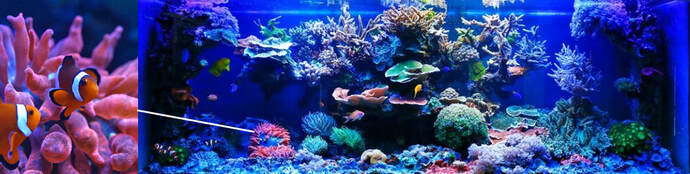
Pictured above, Reef Aquarium including Acropora Coral at the National Oceanography Centre in London using AquaRay LED Lighting.
With higher efficiencies, these are becoming the new king of reef and planted aquarium lighting with many high-end LED manufacturers such as AquaRay, EcoTech, Kessil, & Aqua Illuminations (among others) leading the way.
The better LED lights have the same shimmer effect and "popping" of coral life otherwise found in Metal Halide.
This aquarium light type uses semiconductor technology as its light source. What is noteworthy is that these are "light emitting diodes" NOT bulbs! What difference does this make? The answer is: A LOT! As with any electronic circuit these must have an exact voltage to run correctly/optimally. As well, these are essentially light emitting electronic devices being placed of your aquarium and should be treated as such including good ventilation and high IP water resistance ratings, which unfortunately most LEDs are lacking in IP ratings!
The difficulty in the past is correct wavelength of the emitters, which in part are affected by the drivers/circuitry maintaining correct voltage over all emitters.
The high-quality LED lights do not have as much of the heat problems of Metal Halide & even fluorescent lights (via ballasts), often last 50,000 hours, and some produce less of the yellow/green spectrum light which is less efficient for photosynthesis in many applications (in high-end aquarium LED adjusted configurations) and are very compact. In fact, this lower use of much of the yellow/green light (as a percentage) often makes some "high-end" LEDs look less bright to the human eye, when in fact the opposite is true as per useful light energy (PUR).
The new reef compatible & freshwater planted tank LEDs are likely to take over the market along with the T2, T5, & SHO lights as the top manufacturers of LED fixtures become more readily available as the price comes down, while at the same time PAR & PUR (quality of light) & general aquarium compatibility come up.
Since LEDs emit light only in a very specific direction, the installer also has the option to illuminate a precise area using lenses in specific degrees of angle. For this reason, the LED does not need to produce as many lumens/photons of light as most conventional lights. In conventional lights, many lumens of important light energy are lost due to lack of focus, including all power compacts and fluorescent lights in general, but need higher lumen outputs to achieve the same lighting parameters.
Common "Beam" angles include 120°, 90°, & 60° lenses. These can have a profound impact on PAR numbers too. Examples include 37% of the PAR at a 400mm of depth between a 120° & 60° lens such as used in the AquaBeam 1500s and 2000s (the 120° being lower PAR). Or 54% of the PAR when a 120° lens is compared to a 90° lens (such as used in the BML LED). However light spread is much less for lower beam angles, so understand the tradeoffs!!!
Achieving the correct wavelengths in the correct amount has been the challenge and why a simple LED flashlight has about as much in common to an advanced aquarium LED as a paper glider to a 747-jet airplane. This however is also the advantage as some of the less efficient light spectrums can be omitted with correct emitter bins and proper drivers/circuitry.
With higher efficiencies, these are becoming the new king of reef and planted aquarium lighting with many high-end LED manufacturers such as AquaRay, EcoTech, Kessil, & Aqua Illuminations (among others) leading the way.
The better LED lights have the same shimmer effect and "popping" of coral life otherwise found in Metal Halide.
This aquarium light type uses semiconductor technology as its light source. What is noteworthy is that these are "light emitting diodes" NOT bulbs! What difference does this make? The answer is: A LOT! As with any electronic circuit these must have an exact voltage to run correctly/optimally. As well, these are essentially light emitting electronic devices being placed of your aquarium and should be treated as such including good ventilation and high IP water resistance ratings, which unfortunately most LEDs are lacking in IP ratings!
The difficulty in the past is correct wavelength of the emitters, which in part are affected by the drivers/circuitry maintaining correct voltage over all emitters.
The high-quality LED lights do not have as much of the heat problems of Metal Halide & even fluorescent lights (via ballasts), often last 50,000 hours, and some produce less of the yellow/green spectrum light which is less efficient for photosynthesis in many applications (in high-end aquarium LED adjusted configurations) and are very compact. In fact, this lower use of much of the yellow/green light (as a percentage) often makes some "high-end" LEDs look less bright to the human eye, when in fact the opposite is true as per useful light energy (PUR).
The new reef compatible & freshwater planted tank LEDs are likely to take over the market along with the T2, T5, & SHO lights as the top manufacturers of LED fixtures become more readily available as the price comes down, while at the same time PAR & PUR (quality of light) & general aquarium compatibility come up.
Since LEDs emit light only in a very specific direction, the installer also has the option to illuminate a precise area using lenses in specific degrees of angle. For this reason, the LED does not need to produce as many lumens/photons of light as most conventional lights. In conventional lights, many lumens of important light energy are lost due to lack of focus, including all power compacts and fluorescent lights in general, but need higher lumen outputs to achieve the same lighting parameters.
Common "Beam" angles include 120°, 90°, & 60° lenses. These can have a profound impact on PAR numbers too. Examples include 37% of the PAR at a 400mm of depth between a 120° & 60° lens such as used in the AquaBeam 1500s and 2000s (the 120° being lower PAR). Or 54% of the PAR when a 120° lens is compared to a 90° lens (such as used in the BML LED). However light spread is much less for lower beam angles, so understand the tradeoffs!!!
Achieving the correct wavelengths in the correct amount has been the challenge and why a simple LED flashlight has about as much in common to an advanced aquarium LED as a paper glider to a 747-jet airplane. This however is also the advantage as some of the less efficient light spectrums can be omitted with correct emitter bins and proper drivers/circuitry.
An example of a new emitter developed just for photosynthetically sensitive reef inhabitants is the 'Osram Olson NP Blue'. This patented emitter primarily targets the FULL spectrum of blue necessary for phototropic response, as well it also contains light energy in the full spectrum of PAR, unlike other blue emitters that have come before it.
In my opinion this is one of the most profound recent developments for aquarium reef LED lighting of late, as ALL other emitters used are either exact bins used for multiple generic applications or in the case of many licensed Cree emitters use emitter bins that are tweaked for aquarium use. While this Osram Olson NP Blue is a SPECIFIC emitter designed for the PAR requirements of many if not most light sensitive reef inhabitants. It is currently used in the AAP/AquaRay AquaBeam Ocean Blue NP 1500, AquaBeam Coral Colour Plus 1500, and in the more focused AquaBeam Reef White 2000 Fixture.
Product Source:
• AAP/AquaRay Reef White NP 2000, Coral Colour Plus 1500, & Ocean Blue NP 1500 Ultima
In my opinion this is one of the most profound recent developments for aquarium reef LED lighting of late, as ALL other emitters used are either exact bins used for multiple generic applications or in the case of many licensed Cree emitters use emitter bins that are tweaked for aquarium use. While this Osram Olson NP Blue is a SPECIFIC emitter designed for the PAR requirements of many if not most light sensitive reef inhabitants. It is currently used in the AAP/AquaRay AquaBeam Ocean Blue NP 1500, AquaBeam Coral Colour Plus 1500, and in the more focused AquaBeam Reef White 2000 Fixture.
Product Source:
• AAP/AquaRay Reef White NP 2000, Coral Colour Plus 1500, & Ocean Blue NP 1500 Ultima
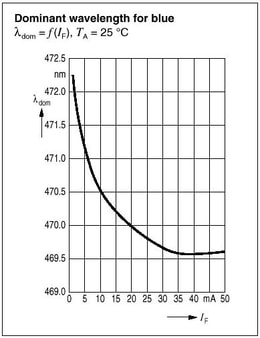
Another problem with many low-end LED fixtures is even if the emitters used are of reasonably efficient bins, these LED fixtures "daisy-chain" their LED emitters together rather than provide the expensive drivers/circuity needed to maintain exacting voltage to each emitter. A plethora of LED fixtures are made in the same Chinese factories using the same lower "hardware store LED technology" under multiple brand names and sold at many aquarium stores and online big box sellers.
This driver/circuitry is partly important for maintaining spectral quality over all emitters without which the important PAR/PUR will not be optimal. As well voltage drops damage emitters which is another reason why many lower end LEDs have short warranty periods.
This driver/circuitry is partly important for maintaining spectral quality over all emitters without which the important PAR/PUR will not be optimal. As well voltage drops damage emitters which is another reason why many lower end LEDs have short warranty periods.
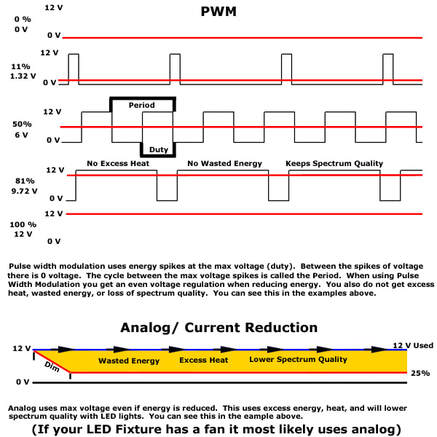
As well "pulse width modulation" (PWM) is best used for controlling the dimming of these emitters so there is no change to the spectral output as opposed to using "current reduction" (aka “linear or analog reduction”) used by many (most) brands of LED fixtures of which the result again is less than optimal PUR and wasted energy as heat instead of light energy. The overall result is lesser quality light energy from these LED lights that employ dozens of emitters, poor drivers, and current reduction controllers. As well, the other result of not utilizing PWM is the same voltage being used when the light is dimmed, which lowers the lifespan of your emitters/LED fixture.
Reference:
• How to Dim an LED Without Compromising Light Quality
As previously noted, this also results in more heat output and often the requirement of fans by these LEDs. This excess heat being driven away by fans simply equals input energy (joules) that is NOT GOING TO LIGHTING YOUR AQUARIUM! In other words, it requires a higher wattage for a "Current reduction" LED fixture to have the same light output of one utilizing PWM. As well, electrical usage with "current reduction" is higher and considerably higher when lights are dimmed such as at night which adds considerably to operating costs of any light not utilizing PWM (which is most).
Speaking of fans, besides the wasted energy, these fans make good waterproofing/resistance very difficult. This is why most LED fixtures have a waterproof rating of IP66 or less. This means your electronic lighting device is being placed in a wet environment with a risk of failure over time or especially if dropped in the water. ONLY the AAP AquaRay LEDs have a IP67 rating combined with a full 5-year replacement warranty and can actually be dropped in the water for a short time.
Another aspect to consider is that unlike fluorescent, incandescent, and other lighting types; very specific emitters require circuitry/drivers similar to your computer.
Simply put, the more emitters along with more specific light output requirements, the more complex and expensive the circuitry and thus NO LED fixture is going to have specific output light energy with say 100+ emitters AND be even remotely close in price to one using 10 emitters if both are using correct LED driver circuitry. The SB Reef Light, TaoTronics, Finnex, Satellite, & Fluval are a good examples of LEDs to avoid for this reason if one seeks the highest output of efficient PAR per watt of input energy used, not that these do not work, they just need much more energy for the same results as a high end LED using the best emitters, drivers, & PWM (as well, the warranties of ALL LEDs utilizing lower tech drivers, low water resistance ratings, and "Current reduction" is considerably shorter)
It is also in the area of emitter development where-by development costs are incurred and where many who do not understand the business aspects of these costs, will then question why one LED manufacturer has or can have exclusive patent rights or similar. Basically ANY 'high end' developer is going to want to recover development costs as quickly as possible and "off the shelf" sales are NOT the way to do this. The facts are, TMC, CRee, Bridgelux, Osram Olsam, etc. are no different than any other manufacturers in other businesses.
What is also noteworthy is that these best licensed emitters can be driven at higher voltages. As an example, the standard XB-D White LED can produce 139 lumens when driven at 350 mA. However, the licensed version (used in the GroBeam) can be driven at 700 mA producing 206 lumens with an efficiency of 86 lm/W and thus a much higher output than most LEDs used.
In the end, we can prove our LED Light's efficiency by comparing PAR at the same depth (15" of air is the standard). Using LED fixtures of similar lens angles (120/unlensed to 120, 90 to 90, etc.). Take the input wattage and divide it by the PAR reading. You will find efficiencies as high as .08 watt of input energy per point of PAR in the AAP Reef White NP 2000 LED to as low as 2.7 watt per point of PAR in the Beamswork EA Timer FSPEC LED. Most of the better LEDs are under .30 watt with most falling in the .4-to-.50-watt range such as the well marketed but below average efficiency SB Reef Light.
Reference:
• Cree XLamp XB-D
Reference:
• How to Dim an LED Without Compromising Light Quality
As previously noted, this also results in more heat output and often the requirement of fans by these LEDs. This excess heat being driven away by fans simply equals input energy (joules) that is NOT GOING TO LIGHTING YOUR AQUARIUM! In other words, it requires a higher wattage for a "Current reduction" LED fixture to have the same light output of one utilizing PWM. As well, electrical usage with "current reduction" is higher and considerably higher when lights are dimmed such as at night which adds considerably to operating costs of any light not utilizing PWM (which is most).
Speaking of fans, besides the wasted energy, these fans make good waterproofing/resistance very difficult. This is why most LED fixtures have a waterproof rating of IP66 or less. This means your electronic lighting device is being placed in a wet environment with a risk of failure over time or especially if dropped in the water. ONLY the AAP AquaRay LEDs have a IP67 rating combined with a full 5-year replacement warranty and can actually be dropped in the water for a short time.
Another aspect to consider is that unlike fluorescent, incandescent, and other lighting types; very specific emitters require circuitry/drivers similar to your computer.
Simply put, the more emitters along with more specific light output requirements, the more complex and expensive the circuitry and thus NO LED fixture is going to have specific output light energy with say 100+ emitters AND be even remotely close in price to one using 10 emitters if both are using correct LED driver circuitry. The SB Reef Light, TaoTronics, Finnex, Satellite, & Fluval are a good examples of LEDs to avoid for this reason if one seeks the highest output of efficient PAR per watt of input energy used, not that these do not work, they just need much more energy for the same results as a high end LED using the best emitters, drivers, & PWM (as well, the warranties of ALL LEDs utilizing lower tech drivers, low water resistance ratings, and "Current reduction" is considerably shorter)
It is also in the area of emitter development where-by development costs are incurred and where many who do not understand the business aspects of these costs, will then question why one LED manufacturer has or can have exclusive patent rights or similar. Basically ANY 'high end' developer is going to want to recover development costs as quickly as possible and "off the shelf" sales are NOT the way to do this. The facts are, TMC, CRee, Bridgelux, Osram Olsam, etc. are no different than any other manufacturers in other businesses.
What is also noteworthy is that these best licensed emitters can be driven at higher voltages. As an example, the standard XB-D White LED can produce 139 lumens when driven at 350 mA. However, the licensed version (used in the GroBeam) can be driven at 700 mA producing 206 lumens with an efficiency of 86 lm/W and thus a much higher output than most LEDs used.
In the end, we can prove our LED Light's efficiency by comparing PAR at the same depth (15" of air is the standard). Using LED fixtures of similar lens angles (120/unlensed to 120, 90 to 90, etc.). Take the input wattage and divide it by the PAR reading. You will find efficiencies as high as .08 watt of input energy per point of PAR in the AAP Reef White NP 2000 LED to as low as 2.7 watt per point of PAR in the Beamswork EA Timer FSPEC LED. Most of the better LEDs are under .30 watt with most falling in the .4-to-.50-watt range such as the well marketed but below average efficiency SB Reef Light.
Reference:
• Cree XLamp XB-D
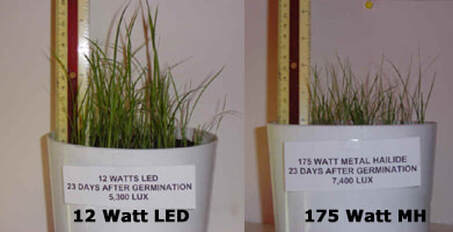
|
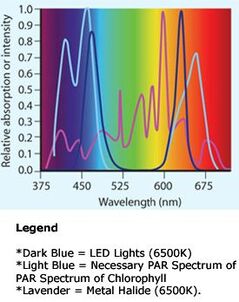
|
Controlled Tests with Plants and The Aquatic Life Implications: As previously noted in the "Useful Energy Section", tests for plant nurseries (Green House, Hydroponics) full spectrum LEDs such as the newer generation AAP GroBeam Aquarium Lights, LED Grow Lights, or even the older generation LED Grow Lights have been proven to surpass even Metal Halide Lights in both growth and useful output.
The above left picture is the plant growth results comparing the same Kelvin output LED and Metal Halide Lights as measured by a PAR Meter (please click to enlarge view).
The above right picture shows the useful PAR light energy of a MH compared to a LED Light (both full spectrum daylight). Please note that this is an older generation "Full Spectrum Daylight" LED used in this controlled test, not the newest generation GroBeam or higher Kelvin Marine White 14000K.
Implications of these tests: This controlled test has aquatic implications, as photosynthesis is the same whether it be a terrestrial plant, a freshwater aquatic plant, or symbiotic zooanthellic algae found in corals. The main difference would be that light energy is quickly absorbed by water, especially red-light waves and many modern high-end LED fixtures such as an EcoTech Radion, AI Sol Vega Blue, ZetLight ZT 6600, AAP Fiji Blue, AAP Ocean Blue NP, and AAP Reef White 2000 produce the light energy for deeper aquarium water penetration more comparable to the popular 20k "Radium" Metal Halides.
Reference:
• PUR in Aquarium Lighting - Depth Penetration
It is still easy to make assumptions from the raw data based on this study with plants that a 12-Watt High Output LED should easily replace one 175-Watt Metal Halide MH of similar rating for marine applications.
Product Resource 12-Watt examples include:
• AquaRay Mini 400
• AquaRay Mini 500
• AAP GroBeam 600 - for Planted Aquariums or Refugiums
• AAP AquaBeam 600 Reef White - for Marine Reef Aquariums
• AAP AquaBeam 600 Marine Blue - for Marine Reef Aquariums
The above left picture is the plant growth results comparing the same Kelvin output LED and Metal Halide Lights as measured by a PAR Meter (please click to enlarge view).
The above right picture shows the useful PAR light energy of a MH compared to a LED Light (both full spectrum daylight). Please note that this is an older generation "Full Spectrum Daylight" LED used in this controlled test, not the newest generation GroBeam or higher Kelvin Marine White 14000K.
Implications of these tests: This controlled test has aquatic implications, as photosynthesis is the same whether it be a terrestrial plant, a freshwater aquatic plant, or symbiotic zooanthellic algae found in corals. The main difference would be that light energy is quickly absorbed by water, especially red-light waves and many modern high-end LED fixtures such as an EcoTech Radion, AI Sol Vega Blue, ZetLight ZT 6600, AAP Fiji Blue, AAP Ocean Blue NP, and AAP Reef White 2000 produce the light energy for deeper aquarium water penetration more comparable to the popular 20k "Radium" Metal Halides.
Reference:
• PUR in Aquarium Lighting - Depth Penetration
It is still easy to make assumptions from the raw data based on this study with plants that a 12-Watt High Output LED should easily replace one 175-Watt Metal Halide MH of similar rating for marine applications.
Product Resource 12-Watt examples include:
• AquaRay Mini 400
• AquaRay Mini 500
• AAP GroBeam 600 - for Planted Aquariums or Refugiums
• AAP AquaBeam 600 Reef White - for Marine Reef Aquariums
• AAP AquaBeam 600 Marine Blue - for Marine Reef Aquariums
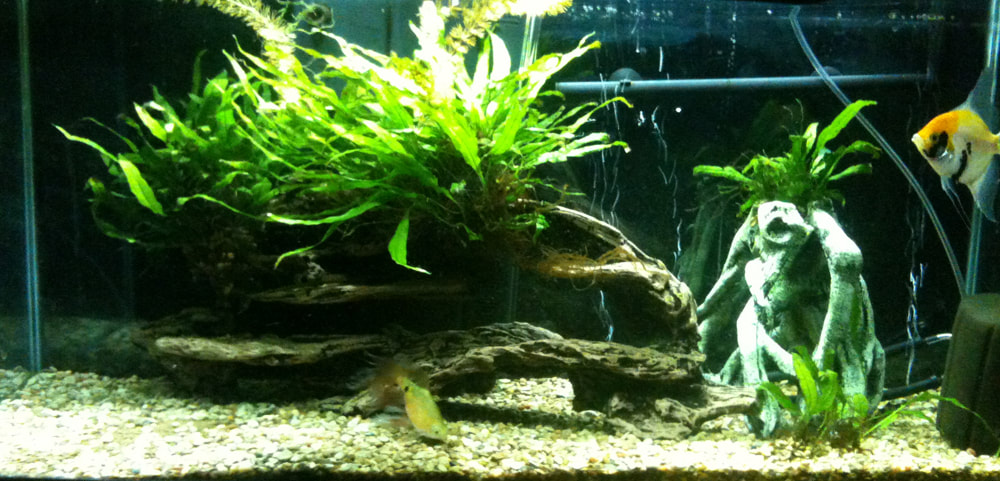
|
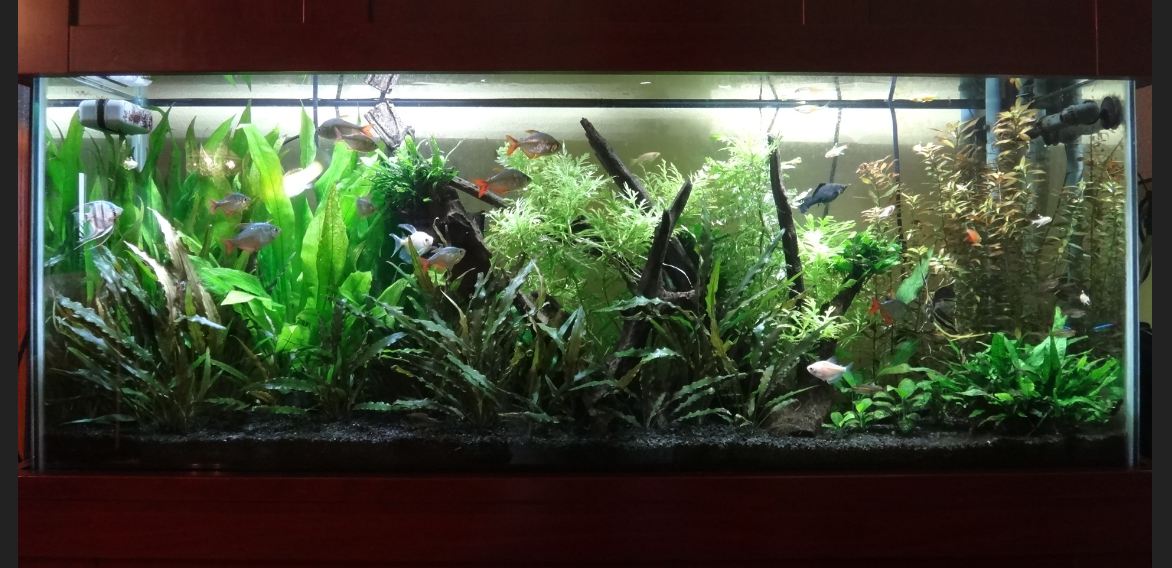
|
The first to the left is of a 40-gallon freshwater aquarium with just ONE "AAP GroBeam 600 12 Watt LED" as an example of what just 12 watts of high-end emitter LED light can do! The second to the right is of a 75 gallon with TWO GroBeam 1000 LEDs which is essentially over kill, but the results were spectacular within just days! It is also noteworthy that this tank has a center brace, yet there is no noticeable shadow.
Below is 5-foot 100-gallon reef aquarium with only four AquaRay 600s (2 Marine blue & 2 Reef White 600s). We would recommend higher wattage of the high output AquaRay lights, but this shows just how efficient these LED lights are per input energy!
Below is 5-foot 100-gallon reef aquarium with only four AquaRay 600s (2 Marine blue & 2 Reef White 600s). We would recommend higher wattage of the high output AquaRay lights, but this shows just how efficient these LED lights are per input energy!
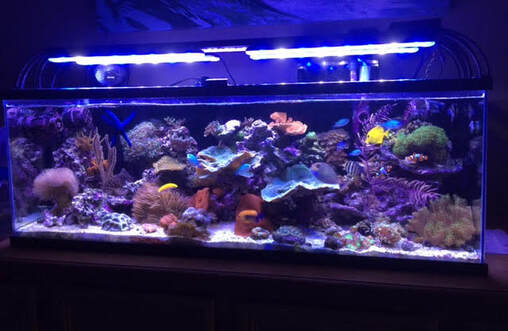
SOME HISTORY: LEDs were first designed to improve on the amount of energy used and heat produced by common aquarium lighting methods. There were mixed reviews on the older generation larger units such as the Solaris and even earlier TMC LEDs as well when compared to MH light fixtures. Even though much less energy was used, I personally did not find LEDs practical for Reef or Planted Aquarium Lighting until 2008. However, the newer ZetLight, Aqua Illuminations, Ecotech Marine, Kessil, and especially the 3rd -4th generation AquaBeam/GroBeam are a vast improvement in price and efficient PAR/PUR output. In fact, at the price of the many of the better LED Aquarium Lights coupled with the 50,000-hour lifespan their actual light cost per hour for comparable output is actually favorable to most T5 aquarium lights (5-year warranty for AquaRay, 1 year warranty for others listed above).
However, of late, this history has been lost due to slick marketing of over-the-top energy wasting LED fixtures that actually do little to improve plant or coral growth, but like light fixtures of old produce copious amounts of heat that creates further issues, including shortening the life of fixtures employing such methods.
However, of late, this history has been lost due to slick marketing of over-the-top energy wasting LED fixtures that actually do little to improve plant or coral growth, but like light fixtures of old produce copious amounts of heat that creates further issues, including shortening the life of fixtures employing such methods.
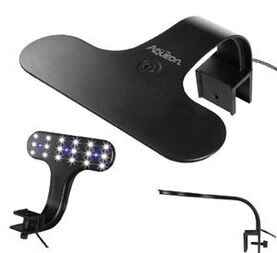
AAP Aqueon Freshwater Aquarium LED: This is not to argue that there is a place for entry level LED lights, just do your homework and understand that purchasing high input wattage lights does NOT mean you are getting the most efficient LED. If you need an entry LED light, especially for community or low/medium light planted aquariums, purchase one that is meant for such without the slick marketing. The Aqueon LED pictured above is just one such example.
Resource:
• Aqueon Freshwater Reg. & Planted Aquarium LED Clip-On Light
Product Sources to support this FREE information:
• AAP/TMC AquaRay LED Aquarium Lighting Systems
(Please avoid a parasite retailer selling out of a home with an official sounding "Aquaray Lighting" name that has paid their way up on Google. Not only do they not have the expertise or customer service of AAP, once their inventory is gone, they likely will not be around to service your warranty.)
Resource:
• Aqueon Freshwater Reg. & Planted Aquarium LED Clip-On Light
Product Sources to support this FREE information:
• AAP/TMC AquaRay LED Aquarium Lighting Systems
(Please avoid a parasite retailer selling out of a home with an official sounding "Aquaray Lighting" name that has paid their way up on Google. Not only do they not have the expertise or customer service of AAP, once their inventory is gone, they likely will not be around to service your warranty.)
More about Emitters: As I noted earlier, not all emitters are equal even with the open-source Cree emitters, commonly sold for other applications. These are only as good as their correct wavelength output (Kelvin Temperature/Nanometers). One cannot compare a computer that uses an exclusive patented Intel processor to one that uses maybe a similar, but generic version of this processor. As with a computer processor company, an LED emitter manufacturer is going to have exclusive licenses/patents as well as generic versions.
What's noteworthy is the latest licensed version of even the newest Cree emitters are not available over the counter to even to the majority of LED builders that do NOT have the license rights. One of the differences between the generic emitter bins and the licensed/patented emitters is that the generic bins are in common light Kelvins used by the lighting industry in general such as "cool white" & "warm white". In other words, NOT SPECIFICALLY designed or even "tweaked" for aquarium reef use! There is nothing "magical" about licensing as some would have you believe; it is simple part of business that if you want to tweak a XB-D emitter to certain specification it will cost a licensing fee.
Far worse yet would be the cheaper no name emitters used by manufacturers such as BaiSheng, Epistar, & others sold under a plethora of other names for so-called aquarium use. These use daylight emitters that can vary widely in Kelvin Color output from only 2000K to 6500K and are in reality generally much less efficient for photosynthetic aquarium life use other than just plain light!
Think about why a CFL 10,000K daylight is so much different and more expensive than a common household CFL sold in hardware stores, or the many decorative LED aquarium lights or even those for home or flashlight use. Try using one of these to grow your delicate coral or plants (the answer is they will not without use of many). This is the reason most earlier LED aquarium lights were not adequate for supporting life properly until about 2008-9.
Based on email I get, forums I regularly read, & YouTube videos (for DIY LED Aquarium Lights), many seem to make this very INCORRECT assumption about emitters, drivers, PWM, wasted heat energy, etc. This has resulted in a plethora LED lights flooding the market that are non-reef capable, marginally reef/planted capable or very reef/planted capable, BUT often requiring 3-4 times the input wattage for EQUAL efficient PAR! Basically, one is back to the high energy input of a MH, but now in a LED. It is NOT that many of these LEDs cannot keep photosynthetic life as we know these lights can and do quite well from practical experience, these are simply less efficient due to wasted heat energy, use of more of the less efficient, yellow, amber, green, or binned emitters; QUITE SIMPLE!
These same older generation emitters, controller technology & drivers are the reason I did not recommend LEDs of ANY brand for "higher end" aquarium applications until 2008 (readers of this VERY constantly evolving article in 2007 would note this too). However NOW we have many reef/planted aquarium capable LED lights and the only thing that separates most are bells & whistles, cost, efficiency of energy input to output, colors one might desire (albeit not necessarily what the photosynthetic life is more efficient utilizing), water proofing/resistance, and warranty. Even in cost, often the other factors will override an initially low cost of many popular LED fixtures.
As noted earlier, another common LED emitter usage is "cool white", "warm white", and "neutral white" by many LED manufacturers so as to obtain necessary efficient PAR spectrums and a pleasing color through a shotgun approach. These same LED manufacturers then disguise their LEDs using "cool features" and ramped up input wattage to drive high PAR numbers to sell these otherwise inferior LEDs as per PAR/PUR delivered for wattage used. We know from the history of aquarium lighting, that a couple generations back we used 4-6 warm white T12 fluorescent lights over say a 60-gallon aquarium for a planted aquarium. When Trichromatic T12 lamps were introduced, we were able to cut the lamps needed by 1/3 to 1/2, so why would you go backwards in efficiency with your LED?
Often these colored emitters are used to allow the user to blend colors so that many of these LEDs can be used in both Reef and high light planted aquariums. This use of colors such as red and green is popular in particular for high end planted aquarium aquascapers looking to bring out certain colors, which I cannot argue this as these do, but I admit I prefer a more natural high noon daylight look in planted aquariums or a more natural under water look one would find on a reef than many of these lights produce.
I should also remind readers that when tuning in specific color combinations, this results in 40% or more loss of stated PAR output since not all emitters are running at full potential. HOWEVER, this is not the case of the Aqua-Illuminations Hydra HD since this LED allows the user to drive light colors at more than 100% when another color is turned down (so that 100% of the input energy is indeed utilized).
This said, this does not make these LED fixtures bad, just less efficient using much more input electricity for the same results and often the result is lower PUR spectral efficiency and fixture lifespan (hence the one-year warranty of most of these high-end lights that perform all these functions). Good examples of the fixtures that are otherwise well built (no daisy chained emitters, top notch drivers) include the: Kessil, V2 illuminair (Zetlight), and the EcoTech.
Another noteworthy FACT (as noted earlier in this article) is the green light energy produced by these fixtures is less useful for Zooxanthellae photosynthesis and these same photosynthetic marine lives have adapted to an environment of much more blue nanometer bands of light energy and little red is required nor does it penetrate! PAR readings based on high wattage inputs are often used to promote these LEDs, however the quality of light output per input watt is lower.
For the lower quality build units using multiple daisy chained emitters (often dozens) and poor drivers, the end result is many of these albeit reef capable LED fixtures such as the Taotronics require 120 watts of input electricity to produce the SAME PUR as a 30 Watt AquaRay AquaBeam Ultima due lower emitter PAR efficiency, the use of "Current Reduction", and along with other circuitry design issues expend more heat energy that could be going to light energy.
In electricity alone at the average USA cost of .13 per kWh, run at 12 hours per day this 90-watt difference equals a $51 savings in just ONE year!!!
Then throw in a shorter warranty (as low as 180 days) and a water resistance rating that does not fully protect your electronic light emitting device and what have you got in price savings when it goes belly up in a year or two?
Another misunderstanding about LED emitters is targeting the responsive wavelength. While exact coral responsiveness wavelengths are unknown, much is known in a broader sense (and even more knowledge is growing, such as the "blue band" of coral responsiveness). For example, we do know that much of the yellow and green bands are 30%-80% less efficient for most photosynthetic corals, clams, etc. (although under 24% green light can be useful, but over 25% it is actually detrimental.)
This has been a controversial topic in a few fragging circles, when it comes to a few red corals such as Red Acans. I have found little to support the claims that these corals fade to orange under correctly applied LED Lights. That said, while some have proposed that a lack of lower blue nanometer light output is the problem, since I, nor others I trust in my research have witnessed this phenomenon, I put forth that it is a missing photopigment (phycoerythrin) found in cyanobacteria which is living in symbiosis with the coral host (Ref: Mazel et al., 2004).
Since many overload on blue emitters, and admittedly most "better" LEDs lack as much of the yellow nanometer light cyanobacteria need to thrive, I feel this (along with specimen placement) is the possible cause and why those who use a good mix of LEDs or even LEDs with T2s or T5s have not observed this phenomenon.
Use of LED to prevent Red Slime: Another positive attribute of LED Aquarium lights as per s recent study (August of 2009) is that LED used in marine aquariums that suffer with Marine Red Slime Algae (Cyanobacteria) can immediately eradicate Red Slime algae when used in a full spectrum lighting configuration. These "immediate" results were just two weeks.
Reference:
• Red Slime Algae, Cyanobacteria
LED Summary: The bottom line is when you compare an LED Aquarium light to the many popular CFLs and even T5s in terms of lumens per watt, focused lumens, PAR, PUR, lower wasted yellow/green light energy, low heat output, energy consumption, long life (25,000 to 50,000 hours vs. 8000 hours), the modern recent generations of LED Fixtures are generally the best available aquarium light. This includes the patented emitter ultra premium high PUR per watt AquaRay AquaBeam or GroBeam LEDs as well as the still VERY capable Aqua Illuminations, EcoTech Radion, ZetLight (aka Maxspect), and few others. Most premium LEDs are a better light even in long term cost since (as an example) a 12 Watt Aqua Ray GroBeam 6500K daylight (either #600 Strip or Mini #400 Tile) can easily replace a up to a 80 Watt power compact (also daylight) when you compare ALL aspects of lighting as presented in this article.
When compared to even older T8/T12 aquarium lights, a fourth generation AAP AquaBeam & GroBeam High End LEDs require only 15% (or less) of the wattage for the required light energy of a planted or reef aquarium. This is as little as .6 watt per gallon for high light planted aquariums and .8 watt per gallon for Reef for the AAP AquaRay and 1.25 -1.5 watt per gallon for the ZetLight, EcoTech & Aqua Illuminations, and 1.75 -2.25 for many other LEDs such as the Ocean Revive, Taotronics, etc. (Acroporas may require a higher wattage input per gallon).
Any flaws of LED aquarium lights are quickly disappearing and based on the energy savings for the premium high PUR LEDs with PWM technology as compared to MH. In fact, for Planted Freshwater the top LED Lights (with the highest PUR) have few limits in their applications.
What's noteworthy is the latest licensed version of even the newest Cree emitters are not available over the counter to even to the majority of LED builders that do NOT have the license rights. One of the differences between the generic emitter bins and the licensed/patented emitters is that the generic bins are in common light Kelvins used by the lighting industry in general such as "cool white" & "warm white". In other words, NOT SPECIFICALLY designed or even "tweaked" for aquarium reef use! There is nothing "magical" about licensing as some would have you believe; it is simple part of business that if you want to tweak a XB-D emitter to certain specification it will cost a licensing fee.
Far worse yet would be the cheaper no name emitters used by manufacturers such as BaiSheng, Epistar, & others sold under a plethora of other names for so-called aquarium use. These use daylight emitters that can vary widely in Kelvin Color output from only 2000K to 6500K and are in reality generally much less efficient for photosynthetic aquarium life use other than just plain light!
Think about why a CFL 10,000K daylight is so much different and more expensive than a common household CFL sold in hardware stores, or the many decorative LED aquarium lights or even those for home or flashlight use. Try using one of these to grow your delicate coral or plants (the answer is they will not without use of many). This is the reason most earlier LED aquarium lights were not adequate for supporting life properly until about 2008-9.
Based on email I get, forums I regularly read, & YouTube videos (for DIY LED Aquarium Lights), many seem to make this very INCORRECT assumption about emitters, drivers, PWM, wasted heat energy, etc. This has resulted in a plethora LED lights flooding the market that are non-reef capable, marginally reef/planted capable or very reef/planted capable, BUT often requiring 3-4 times the input wattage for EQUAL efficient PAR! Basically, one is back to the high energy input of a MH, but now in a LED. It is NOT that many of these LEDs cannot keep photosynthetic life as we know these lights can and do quite well from practical experience, these are simply less efficient due to wasted heat energy, use of more of the less efficient, yellow, amber, green, or binned emitters; QUITE SIMPLE!
These same older generation emitters, controller technology & drivers are the reason I did not recommend LEDs of ANY brand for "higher end" aquarium applications until 2008 (readers of this VERY constantly evolving article in 2007 would note this too). However NOW we have many reef/planted aquarium capable LED lights and the only thing that separates most are bells & whistles, cost, efficiency of energy input to output, colors one might desire (albeit not necessarily what the photosynthetic life is more efficient utilizing), water proofing/resistance, and warranty. Even in cost, often the other factors will override an initially low cost of many popular LED fixtures.
As noted earlier, another common LED emitter usage is "cool white", "warm white", and "neutral white" by many LED manufacturers so as to obtain necessary efficient PAR spectrums and a pleasing color through a shotgun approach. These same LED manufacturers then disguise their LEDs using "cool features" and ramped up input wattage to drive high PAR numbers to sell these otherwise inferior LEDs as per PAR/PUR delivered for wattage used. We know from the history of aquarium lighting, that a couple generations back we used 4-6 warm white T12 fluorescent lights over say a 60-gallon aquarium for a planted aquarium. When Trichromatic T12 lamps were introduced, we were able to cut the lamps needed by 1/3 to 1/2, so why would you go backwards in efficiency with your LED?
Often these colored emitters are used to allow the user to blend colors so that many of these LEDs can be used in both Reef and high light planted aquariums. This use of colors such as red and green is popular in particular for high end planted aquarium aquascapers looking to bring out certain colors, which I cannot argue this as these do, but I admit I prefer a more natural high noon daylight look in planted aquariums or a more natural under water look one would find on a reef than many of these lights produce.
I should also remind readers that when tuning in specific color combinations, this results in 40% or more loss of stated PAR output since not all emitters are running at full potential. HOWEVER, this is not the case of the Aqua-Illuminations Hydra HD since this LED allows the user to drive light colors at more than 100% when another color is turned down (so that 100% of the input energy is indeed utilized).
This said, this does not make these LED fixtures bad, just less efficient using much more input electricity for the same results and often the result is lower PUR spectral efficiency and fixture lifespan (hence the one-year warranty of most of these high-end lights that perform all these functions). Good examples of the fixtures that are otherwise well built (no daisy chained emitters, top notch drivers) include the: Kessil, V2 illuminair (Zetlight), and the EcoTech.
Another noteworthy FACT (as noted earlier in this article) is the green light energy produced by these fixtures is less useful for Zooxanthellae photosynthesis and these same photosynthetic marine lives have adapted to an environment of much more blue nanometer bands of light energy and little red is required nor does it penetrate! PAR readings based on high wattage inputs are often used to promote these LEDs, however the quality of light output per input watt is lower.
For the lower quality build units using multiple daisy chained emitters (often dozens) and poor drivers, the end result is many of these albeit reef capable LED fixtures such as the Taotronics require 120 watts of input electricity to produce the SAME PUR as a 30 Watt AquaRay AquaBeam Ultima due lower emitter PAR efficiency, the use of "Current Reduction", and along with other circuitry design issues expend more heat energy that could be going to light energy.
In electricity alone at the average USA cost of .13 per kWh, run at 12 hours per day this 90-watt difference equals a $51 savings in just ONE year!!!
Then throw in a shorter warranty (as low as 180 days) and a water resistance rating that does not fully protect your electronic light emitting device and what have you got in price savings when it goes belly up in a year or two?
Another misunderstanding about LED emitters is targeting the responsive wavelength. While exact coral responsiveness wavelengths are unknown, much is known in a broader sense (and even more knowledge is growing, such as the "blue band" of coral responsiveness). For example, we do know that much of the yellow and green bands are 30%-80% less efficient for most photosynthetic corals, clams, etc. (although under 24% green light can be useful, but over 25% it is actually detrimental.)
This has been a controversial topic in a few fragging circles, when it comes to a few red corals such as Red Acans. I have found little to support the claims that these corals fade to orange under correctly applied LED Lights. That said, while some have proposed that a lack of lower blue nanometer light output is the problem, since I, nor others I trust in my research have witnessed this phenomenon, I put forth that it is a missing photopigment (phycoerythrin) found in cyanobacteria which is living in symbiosis with the coral host (Ref: Mazel et al., 2004).
Since many overload on blue emitters, and admittedly most "better" LEDs lack as much of the yellow nanometer light cyanobacteria need to thrive, I feel this (along with specimen placement) is the possible cause and why those who use a good mix of LEDs or even LEDs with T2s or T5s have not observed this phenomenon.
Use of LED to prevent Red Slime: Another positive attribute of LED Aquarium lights as per s recent study (August of 2009) is that LED used in marine aquariums that suffer with Marine Red Slime Algae (Cyanobacteria) can immediately eradicate Red Slime algae when used in a full spectrum lighting configuration. These "immediate" results were just two weeks.
Reference:
• Red Slime Algae, Cyanobacteria
LED Summary: The bottom line is when you compare an LED Aquarium light to the many popular CFLs and even T5s in terms of lumens per watt, focused lumens, PAR, PUR, lower wasted yellow/green light energy, low heat output, energy consumption, long life (25,000 to 50,000 hours vs. 8000 hours), the modern recent generations of LED Fixtures are generally the best available aquarium light. This includes the patented emitter ultra premium high PUR per watt AquaRay AquaBeam or GroBeam LEDs as well as the still VERY capable Aqua Illuminations, EcoTech Radion, ZetLight (aka Maxspect), and few others. Most premium LEDs are a better light even in long term cost since (as an example) a 12 Watt Aqua Ray GroBeam 6500K daylight (either #600 Strip or Mini #400 Tile) can easily replace a up to a 80 Watt power compact (also daylight) when you compare ALL aspects of lighting as presented in this article.
When compared to even older T8/T12 aquarium lights, a fourth generation AAP AquaBeam & GroBeam High End LEDs require only 15% (or less) of the wattage for the required light energy of a planted or reef aquarium. This is as little as .6 watt per gallon for high light planted aquariums and .8 watt per gallon for Reef for the AAP AquaRay and 1.25 -1.5 watt per gallon for the ZetLight, EcoTech & Aqua Illuminations, and 1.75 -2.25 for many other LEDs such as the Ocean Revive, Taotronics, etc. (Acroporas may require a higher wattage input per gallon).
Any flaws of LED aquarium lights are quickly disappearing and based on the energy savings for the premium high PUR LEDs with PWM technology as compared to MH. In fact, for Planted Freshwater the top LED Lights (with the highest PUR) have few limits in their applications.
Retrofit is also not all that difficult with most better LED systems sold with hardware that makes DIY mounting options quite varied. TMC has an optional mounting system of rails and other parts that expands these mounting capabilities even further while the ZetLight & Maxspect come with a built-in mounting system for aquarium rim mounting.
LED Light systems are easily complimented with T5 Fixtures, T2 fixture for smaller applications, or even the SHO self-ballasted high output CFL for large tank applications.
Product Resources:
• AquaBeam & GroBeam LED Lights
• SHO Aquarium Lights
Finally: I should note to newer readers of this constantly evolving article that may think there is bias toward high end LED lights, you would only be 1/4 correct, as first I do not recommend the plethora of junk LEDs commonly sold and as well if you were to read this same article circa 2007, I did not recommend ANY LED Light, however technology had increased considerably in this arena of aquarium lighting.
LED Light systems are easily complimented with T5 Fixtures, T2 fixture for smaller applications, or even the SHO self-ballasted high output CFL for large tank applications.
Product Resources:
• AquaBeam & GroBeam LED Lights
• SHO Aquarium Lights
Finally: I should note to newer readers of this constantly evolving article that may think there is bias toward high end LED lights, you would only be 1/4 correct, as first I do not recommend the plethora of junk LEDs commonly sold and as well if you were to read this same article circa 2007, I did not recommend ANY LED Light, however technology had increased considerably in this arena of aquarium lighting.
Lunar Moonlight
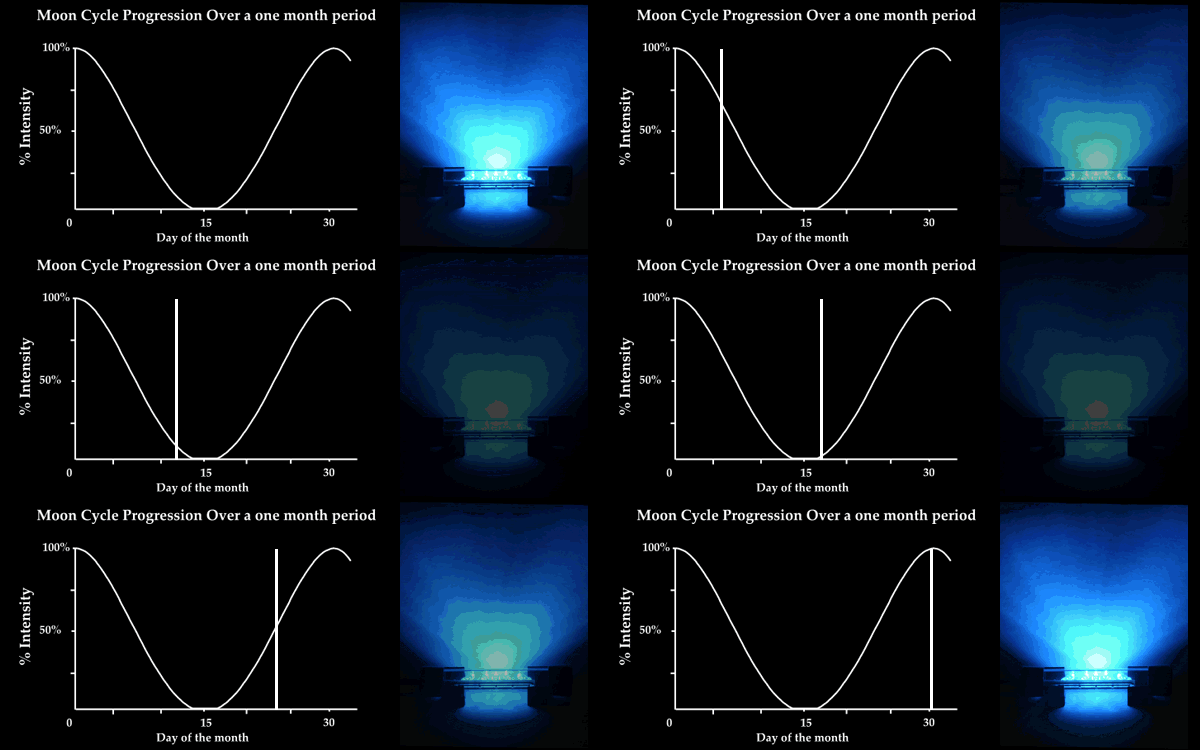
Often LED as noted above are used as lunar or moonlights. This is an area where anecdotal information seems to be the main information available.
This includes the common belief that moonlight should be "blue" when in truth all the moon does is reflect diffused sunlight back to the earth (more during full moons, less during other phases). Dust or moisture can affect the color spectrum seen by the human eye as well (which often makes the light appear blue). This means that a dimmed/diffused daylight is a more accurate production of moonlight. This can be done by fading a Reef White AquaBeam LED as an example.
Essentially these are very popular for marine reef aquariums for both a low level "night light" and for simulating moonlight for corals and coral propagation. Where some of the misinformation comes into play is that many will state that fish need these lights, of which there absolutely no scientific proof and also that corals need these for proper growth which also has no scientific evidence to back this up. Aquarium Moon lights (lunar lights) do nothing to aid in this.
What lunar lights (moonlights) could do with correct programming for the marine reef aquarium is to simulate marine lunar cycles which are necessary for some fish and coral reproduction/propagation, as Corals in the Great Barrier reef spawn 3-7 days following the first 2 Full moons in late spring and early summer. Even here there is still a lot of controversy as to what cycle is best and how much light is best.
From what I personally have observed combined with the opinions of other aquarium professionals is the use of gray nylon filter placed over standard daylights (T2, T5, T8 CFL, etc.) can work as a moonlight; even low level "white" lights such as nightlight bulbs, or even the Rio Mini Sun LED lights can work just fine for this since this has shown to be a more of a low level light issue and timing issue.
Adding or subtracting the amount/intensity seems to be the secret of simulating these cycles which can be accomplish easily either manually or with electronic timers (that can be set to more accurate monthly 29.5-day lunar cycles of lighting). Strategically placing these lights also shows evidence as to properly simulating this effect.
This includes the common belief that moonlight should be "blue" when in truth all the moon does is reflect diffused sunlight back to the earth (more during full moons, less during other phases). Dust or moisture can affect the color spectrum seen by the human eye as well (which often makes the light appear blue). This means that a dimmed/diffused daylight is a more accurate production of moonlight. This can be done by fading a Reef White AquaBeam LED as an example.
Essentially these are very popular for marine reef aquariums for both a low level "night light" and for simulating moonlight for corals and coral propagation. Where some of the misinformation comes into play is that many will state that fish need these lights, of which there absolutely no scientific proof and also that corals need these for proper growth which also has no scientific evidence to back this up. Aquarium Moon lights (lunar lights) do nothing to aid in this.
What lunar lights (moonlights) could do with correct programming for the marine reef aquarium is to simulate marine lunar cycles which are necessary for some fish and coral reproduction/propagation, as Corals in the Great Barrier reef spawn 3-7 days following the first 2 Full moons in late spring and early summer. Even here there is still a lot of controversy as to what cycle is best and how much light is best.
From what I personally have observed combined with the opinions of other aquarium professionals is the use of gray nylon filter placed over standard daylights (T2, T5, T8 CFL, etc.) can work as a moonlight; even low level "white" lights such as nightlight bulbs, or even the Rio Mini Sun LED lights can work just fine for this since this has shown to be a more of a low level light issue and timing issue.
Adding or subtracting the amount/intensity seems to be the secret of simulating these cycles which can be accomplish easily either manually or with electronic timers (that can be set to more accurate monthly 29.5-day lunar cycles of lighting). Strategically placing these lights also shows evidence as to properly simulating this effect.
HID Xenon
HID stands for "High Intensity Discharge", this technology is currently used in high end luxury cars, however there may be aquatic implications here in the future as PAR and other potential issues are worked out. HID lights use an electrical charge to ignite xenon gas (a colorless, heavy, odorless noble gas, which occurs in the Earth's atmosphere in trace amounts) contained in a sealed bulb. The technology of HID automotive lamps is similar to that of common vapor-filled mercury vapor streetlamps.
These Xenon HID lights seem to produce much in the lower chlorophyll A segment of PAR, but currently not as much in the higher infrared part of PAR.
These Xenon HID lights seem to produce much in the lower chlorophyll A segment of PAR, but currently not as much in the higher infrared part of PAR.
Parameters to Consider
• Watts per gallon.
• Lumens per watt.
• Lumen focus.
• PAR (often easiest determined by Kelvin output), although it is important to note that the symbiotic zooxanthellae found in many corals and clams require more of the "blue spike", so high PAR for higher plants is not exactly the same for corals although it is safe to say a PAR reading of 50 mmol will work for most light sensitive corals.
• PUR/Useful Light Energy, probably the most important parameter. Light energy should not waste in a high percentage of yellow/green light spectrum that green plants and zooanthellic algae reflect. Output in relation to bulb length (this is where LEDs and to a lesser extent T2s and T5s excel).
• Lux, I generally only consider this parameter in deeper Reef and occasionally deeper planted freshwater aquarium to determine if I am getting the proper light where it needs to be.
Specimen Placement/Tank Depth: Although not a parameter per say, it still affects lighting decisions and even the few "watts per gallon" generalizations I provide in this article. For instance, any SPS/LPS coral placement deeper than 18-20 inches should rule out most T5 lights and deeper than 24-30 inches rules out many LED lights (24 to 30 inches at least requires the most powerful LEDs such as the AquaBeam 1000 Ultra Reef White or Orphek Nilus Reef LED Light): In these deeper depths the Metal Halide is still king.
The watts per gallon is part of the lighting equation as stated above is highly inaccurate when taken by itself yet may in the aquarium hobby industry still go by this outdated generalization which leaves me scratching my head with all the advances in lighting technology. Taken together, the first FIVE points are the most critical (which does include watts per gallon), but no one of these should be a sole determiner of the lights.
Even a "105-watt Super High Output (SHO) Light" which is an excellent light, especially for planted freshwater or hydroponics applications, when compared apples to apples to the 30-watt GroBeam 1500 Ultima only produces 85% of the same useful light energy despite using more than triple the energy. This is not to say the 105 SHO is not a good light, far from it, especially when one considers the vastly lower price and that this SHO light still out produces most any T12, T8 and T5 (using 6500K for all comparisons); as a generalization (assuming equal Kelvin) the SHO requires only 2 to 2.5 watts per gallon for a "high light planted aquarium".
• Lumens per watt.
• Lumen focus.
• PAR (often easiest determined by Kelvin output), although it is important to note that the symbiotic zooxanthellae found in many corals and clams require more of the "blue spike", so high PAR for higher plants is not exactly the same for corals although it is safe to say a PAR reading of 50 mmol will work for most light sensitive corals.
• PUR/Useful Light Energy, probably the most important parameter. Light energy should not waste in a high percentage of yellow/green light spectrum that green plants and zooanthellic algae reflect. Output in relation to bulb length (this is where LEDs and to a lesser extent T2s and T5s excel).
• Lux, I generally only consider this parameter in deeper Reef and occasionally deeper planted freshwater aquarium to determine if I am getting the proper light where it needs to be.
Specimen Placement/Tank Depth: Although not a parameter per say, it still affects lighting decisions and even the few "watts per gallon" generalizations I provide in this article. For instance, any SPS/LPS coral placement deeper than 18-20 inches should rule out most T5 lights and deeper than 24-30 inches rules out many LED lights (24 to 30 inches at least requires the most powerful LEDs such as the AquaBeam 1000 Ultra Reef White or Orphek Nilus Reef LED Light): In these deeper depths the Metal Halide is still king.
The watts per gallon is part of the lighting equation as stated above is highly inaccurate when taken by itself yet may in the aquarium hobby industry still go by this outdated generalization which leaves me scratching my head with all the advances in lighting technology. Taken together, the first FIVE points are the most critical (which does include watts per gallon), but no one of these should be a sole determiner of the lights.
Even a "105-watt Super High Output (SHO) Light" which is an excellent light, especially for planted freshwater or hydroponics applications, when compared apples to apples to the 30-watt GroBeam 1500 Ultima only produces 85% of the same useful light energy despite using more than triple the energy. This is not to say the 105 SHO is not a good light, far from it, especially when one considers the vastly lower price and that this SHO light still out produces most any T12, T8 and T5 (using 6500K for all comparisons); as a generalization (assuming equal Kelvin) the SHO requires only 2 to 2.5 watts per gallon for a "high light planted aquarium".
Lighting Time & Replacement
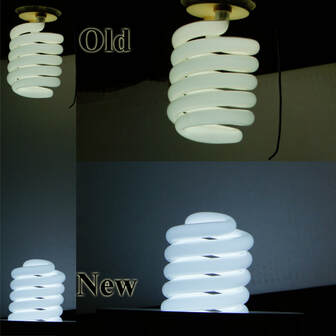
Replacement: ANY fluorescent light used for aquarium applications such as planted aquariums or reef, slowly burns up phosphors and other rare earth elements that produce the light energy necessary for PUR. As with a UVC bulb/lamp used for a UV Sterilizer, these lights go through a "half-life", meaning that a light that is run 12 hours per day that may last 2 years (as per rated life) should be actually replaced every year otherwise these lamps are running at 50% and less of initial light energy production and then often producing much more yellow light and even an imbalance of red that is inducing to more algae and cyanobacteria growth in particular. I have noted in 100s of applications over the years that plant growth decreases as these lights age, even though many think that more red is "good" this clearly shows that an imbalance is NOT!
Product Resource:
• Aquarium UVC Bulbs/Lamps
The picture above clearly demonstrates the difference we can see with just our human eye between new 6400K Daylight SHO and one nearly two years old. The color temperature of the old lamp/light.
Product Resource:
• Aquarium UVC Bulbs/Lamps
The picture above clearly demonstrates the difference we can see with just our human eye between new 6400K Daylight SHO and one nearly two years old. The color temperature of the old lamp/light.
Light Placement
Pendant vs. Canopy with Reflector (Mirror, Aluminum, Mylar): The advantage to a pendant reflector over a canopy with reflective backing (mirror, aluminum or mylar reflector) is that it will radiate downward in a slightly more magnified fashion than a pendent reflector, however the reflector/mirror has one advantage over the pendant and that is more widespread light distribution. A pendent (such as an SHO or Metal Halide) or LEDs hung on rails over an aquarium allows for an open tank which allows for more light energy to reach the tank. The negative is evaporation and possibly aesthetics (which of course comes down to opinion).
If lights are placed in a canopy (which in my opinion looks better) it is generally best to keep a lid on the tank to prevent too much moisture from building up inside the canopy which can also damage lights. I recommend venting the canopy and adding a small fan in at least one of the vents aimed to push air out. This will help cool the inside of the canopy/hood and, just as importantly, help expel moisture. With low heat lights such as LED and T2s, this is of less importance especially for heat, but still helps protect lights from moisture damage.
The use of a reflector such as mylar (even heavy aluminum foil can work, although it tends to degrade from salty moisture over time in my experience) protects the canopy wood from heat and is useful for directing light downward, especially if SHO, T2, T5, or Compact Fluorescent lights are used. BTW, my first choice is Mylar for both reflective properties and longevity. Please see the picture in the T2 Light section of this article for a canopy using Mylar.
The use of lids (glass in particular) does block light energy and gets buildup quite quickly under the lids (although lights exposed to open tanks need to be wiped clean often too), however the choice of lid can minimize energy loss (see the section lower in the article under Marine Light Summary for more about lid choices).
So, this choice comes down more to aesthetics, space, personal preferences, tank arrangement of plants or corals and more.
If lights are placed in a canopy (which in my opinion looks better) it is generally best to keep a lid on the tank to prevent too much moisture from building up inside the canopy which can also damage lights. I recommend venting the canopy and adding a small fan in at least one of the vents aimed to push air out. This will help cool the inside of the canopy/hood and, just as importantly, help expel moisture. With low heat lights such as LED and T2s, this is of less importance especially for heat, but still helps protect lights from moisture damage.
The use of a reflector such as mylar (even heavy aluminum foil can work, although it tends to degrade from salty moisture over time in my experience) protects the canopy wood from heat and is useful for directing light downward, especially if SHO, T2, T5, or Compact Fluorescent lights are used. BTW, my first choice is Mylar for both reflective properties and longevity. Please see the picture in the T2 Light section of this article for a canopy using Mylar.
The use of lids (glass in particular) does block light energy and gets buildup quite quickly under the lids (although lights exposed to open tanks need to be wiped clean often too), however the choice of lid can minimize energy loss (see the section lower in the article under Marine Light Summary for more about lid choices).
So, this choice comes down more to aesthetics, space, personal preferences, tank arrangement of plants or corals and more.
Light Penetration
What is often a bigger issue, especially with deep tanks (over 24 inches) is to allow as much of the blue light (which is found as part of the light spectrum of high PAR Daylight 6400 K lights) as possible through to the tank and often a glass top will block these light rays (over 60%) so using polycarbonate or no lid at all may do more for effectiveness than whether you use a mirror or pendent (see further in this article for more on this subject).
As well for tanks over 24 inches the use of some higher Kelvin in your light "mix" may be necessary for coral tanks or in some cases high light requiring plant tanks (depending upon the environment being replicated, as a high tannin, often shaded Amazon River tanks would not require the light intensity and higher Kelvin output of a Reef Tank).
The use of 14,000 K MH (or even higher Kelvin 20,000K MH) or AquaBeam Reef White 18000K LED in a mix with High PAR 6400 K SHO lights may provide the "mix" necessary for deeper freshwater tanks.
For Marine, even in tanks under 24 inches, the use of actinic blue lights may help provide the correct PAR/PUR to specimens lower in your tanks water column. As an example, a Reef Blue or Fiji Blue LED may also help provide this.
Product Resources:
• AquaBeam 600 Ultima Reef White, Reef Blue, or Fiji Blue LED
• High PAR 6400 K SHO Lights
With the above noted, do not make the mistake of going overboard with blue light in a relatively shallow aquarium. While an aquarium at 20 inches with ANY man-made light is not going to compare to an ocean reef at 20 inches with sunlight, adding 2 to one blue to daylight (as some LED brands or users have done) or all 20,000K lights is not the answer.
See:
• PUR versus PAR in Aquarium Lighting - Including Spectrographs.
Here is the general light spectrum absorption of water:
• Only 73% of the surface light reaches a depth of 1 centimeter (less than a half inch).
• Only 44.5% of the surface light reaches a depth of 1 meter (3.3 feet).
IMPORTANT: Another point about lighting in general is that lower PAR wave lengths of light such as "near" UVA (400-485nm) do not penetrate glass well. I recommend direct lighting (best), quartz, Plexiglas (acrylic), or polycarbonate (Lexan) to optimize PAR light penetration or in particular where near UVA is important. Just make sure to clean your bulbs, Plexiglass or polycarbonate tops regularly to prevent build up that will block light. Even though infrared will penetrate glass better, it will not penetrate dirty glass with algae or hard water deposits on it, so keep your aquarium cover clean for any tank where lighting is important such as FW plants or Reef Aquariums.
Here is a very basic breakdown of PAR Spectrum blocking potential:
• Glass - about 25% will be blocked.
• Acrylic - about 10%.
• Polycarbonate - about 15- 18%.
• Quartz - about .5-2%.
Here are a few light transmission graphs:
As well for tanks over 24 inches the use of some higher Kelvin in your light "mix" may be necessary for coral tanks or in some cases high light requiring plant tanks (depending upon the environment being replicated, as a high tannin, often shaded Amazon River tanks would not require the light intensity and higher Kelvin output of a Reef Tank).
The use of 14,000 K MH (or even higher Kelvin 20,000K MH) or AquaBeam Reef White 18000K LED in a mix with High PAR 6400 K SHO lights may provide the "mix" necessary for deeper freshwater tanks.
For Marine, even in tanks under 24 inches, the use of actinic blue lights may help provide the correct PAR/PUR to specimens lower in your tanks water column. As an example, a Reef Blue or Fiji Blue LED may also help provide this.
Product Resources:
• AquaBeam 600 Ultima Reef White, Reef Blue, or Fiji Blue LED
• High PAR 6400 K SHO Lights
With the above noted, do not make the mistake of going overboard with blue light in a relatively shallow aquarium. While an aquarium at 20 inches with ANY man-made light is not going to compare to an ocean reef at 20 inches with sunlight, adding 2 to one blue to daylight (as some LED brands or users have done) or all 20,000K lights is not the answer.
See:
• PUR versus PAR in Aquarium Lighting - Including Spectrographs.
Here is the general light spectrum absorption of water:
• Only 73% of the surface light reaches a depth of 1 centimeter (less than a half inch).
• Only 44.5% of the surface light reaches a depth of 1 meter (3.3 feet).
IMPORTANT: Another point about lighting in general is that lower PAR wave lengths of light such as "near" UVA (400-485nm) do not penetrate glass well. I recommend direct lighting (best), quartz, Plexiglas (acrylic), or polycarbonate (Lexan) to optimize PAR light penetration or in particular where near UVA is important. Just make sure to clean your bulbs, Plexiglass or polycarbonate tops regularly to prevent build up that will block light. Even though infrared will penetrate glass better, it will not penetrate dirty glass with algae or hard water deposits on it, so keep your aquarium cover clean for any tank where lighting is important such as FW plants or Reef Aquariums.
Here is a very basic breakdown of PAR Spectrum blocking potential:
• Glass - about 25% will be blocked.
• Acrylic - about 10%.
• Polycarbonate - about 15- 18%.
• Quartz - about .5-2%.
Here are a few light transmission graphs:
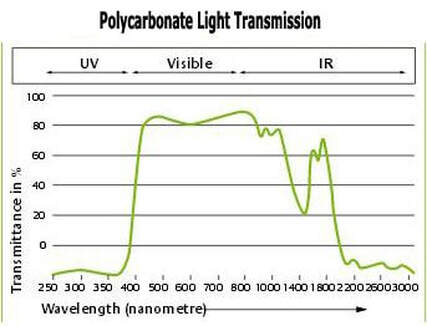
|
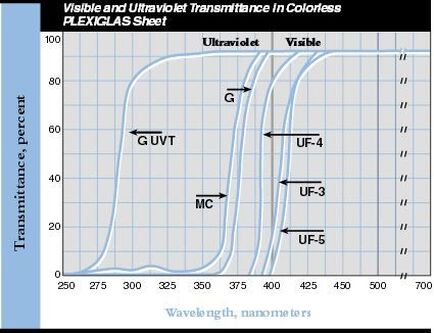
|
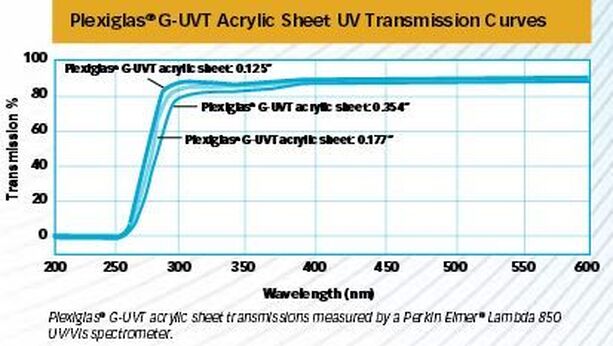
The last graph compares 6 different grades of Plexiglas as per UV transmission, with the 'G' being the best candidate for the widest aquarium applications. However, my understanding is that the GUVT is used by most acrylic aquarium builders.
References:
• Plexiglas Optical & Transmission Characteristic
• Plexiglas® G-UVT
• SABIC Plastics
References:
• Plexiglas Optical & Transmission Characteristic
• Plexiglas® G-UVT
• SABIC Plastics
Specimen Placement
This is an important consideration that is often missed, or not enough weight is given to this part of aquarium lighting and aquascaping.
Reef: Another important point that is often missed by many reef keepers (usually newbies) is even with newer technology high output lights (such as a MH, LED, HO T5, T2, or SHO), specimen placement can make or break a good light system.
As per the previous section as to general light absorption of water, you may need to move certain corals or other light sensitive reef inhabitants as high up in the water column as possible, this is especially important with SPS corals (short polyp stony corals) where placement on the rocks directly under your lights is even more essential. This is not as essential with LPS corals (long polyp stony corals) since they are more commonly found in near the sandy lagoon bottoms.
You may find that you will have to move corals around to find a "sweet spot" in depth, this includes when changing lighting types.
Sometimes in conversations with reef enthusiasts that are questioning different lighting systems/ideas is that it is often missed that the highest light requiring corals (such as SPS) do not grow 50 feet (15 meters) below the surface in the reefs and that these corals will be just below the surface, so regardless of the lights you choose, placement is extremely important. Even less light demanding tropical reef building corals species are restricted to the euphotic zone, the region in the ocean where light penetrates to a depth of approximately 230 feet or 70 meters (there are cold water corals that grow in deeper water, however these are not the reef building corals kept in aquariums that secrete calcium carbonate).
I should also note that with SPS corals in my own experience, that placement low or even in substrate that I have observed the corals getting "eaten away" by bacteria from the bottom up; while this is an anecdotal observation of mine (as other factors were not tested in a controlled scientific study), it is still consideration in coral specimen placement. The bottom line is that you can have the best lighting system that money can buy, but poor placement of specimens can make it all for not.
Another thought as marine tanks in general, is to consider what type of environment you attempting to duplicate; for instance, a Reef Tank set up to duplicate the Great Barrier Reef would require aquascaping and higher power lighting to best replicate this environment. While a marine tank set up to replicate the much more turbid waters off the California coast would not require the same aquascaping or as high power of lighting.
Freshwater: If your lights are for Freshwater plants, I would move the high light requiring plants directly under the lights (I generally elevate them with terracing, which can look quite attractive if done well and serve a dual purpose of aesthetics and better light energy absorption).
Reference:
• Freshwater Aquarium Plant Care, Information
As with marine tanks, consider the environment you are replicating: For instance, an Amazon River environment aquarium (with fish such as Discus) are full of tannins and have many shady areas and so one cannot compare the lighting needs of a tropical reef with the Amazon River. More light and dark spots should be utilized so as to provide a more natural and comfortable environment for your aquarium inhabitants, as well the same intense lighting for the same size Tropical Reef tank should not be used for an Amazon River aquarium of the same size and depth.
Reef: Another important point that is often missed by many reef keepers (usually newbies) is even with newer technology high output lights (such as a MH, LED, HO T5, T2, or SHO), specimen placement can make or break a good light system.
As per the previous section as to general light absorption of water, you may need to move certain corals or other light sensitive reef inhabitants as high up in the water column as possible, this is especially important with SPS corals (short polyp stony corals) where placement on the rocks directly under your lights is even more essential. This is not as essential with LPS corals (long polyp stony corals) since they are more commonly found in near the sandy lagoon bottoms.
You may find that you will have to move corals around to find a "sweet spot" in depth, this includes when changing lighting types.
Sometimes in conversations with reef enthusiasts that are questioning different lighting systems/ideas is that it is often missed that the highest light requiring corals (such as SPS) do not grow 50 feet (15 meters) below the surface in the reefs and that these corals will be just below the surface, so regardless of the lights you choose, placement is extremely important. Even less light demanding tropical reef building corals species are restricted to the euphotic zone, the region in the ocean where light penetrates to a depth of approximately 230 feet or 70 meters (there are cold water corals that grow in deeper water, however these are not the reef building corals kept in aquariums that secrete calcium carbonate).
I should also note that with SPS corals in my own experience, that placement low or even in substrate that I have observed the corals getting "eaten away" by bacteria from the bottom up; while this is an anecdotal observation of mine (as other factors were not tested in a controlled scientific study), it is still consideration in coral specimen placement. The bottom line is that you can have the best lighting system that money can buy, but poor placement of specimens can make it all for not.
Another thought as marine tanks in general, is to consider what type of environment you attempting to duplicate; for instance, a Reef Tank set up to duplicate the Great Barrier Reef would require aquascaping and higher power lighting to best replicate this environment. While a marine tank set up to replicate the much more turbid waters off the California coast would not require the same aquascaping or as high power of lighting.
Freshwater: If your lights are for Freshwater plants, I would move the high light requiring plants directly under the lights (I generally elevate them with terracing, which can look quite attractive if done well and serve a dual purpose of aesthetics and better light energy absorption).
Reference:
• Freshwater Aquarium Plant Care, Information
As with marine tanks, consider the environment you are replicating: For instance, an Amazon River environment aquarium (with fish such as Discus) are full of tannins and have many shady areas and so one cannot compare the lighting needs of a tropical reef with the Amazon River. More light and dark spots should be utilized so as to provide a more natural and comfortable environment for your aquarium inhabitants, as well the same intense lighting for the same size Tropical Reef tank should not be used for an Amazon River aquarium of the same size and depth.
Tank Set-Up Lighting Suggestions

Please note: The AquaRay LED is used as an example, other 'high end' LEDs such as the ZetLight, EcoTech, AquaIllumination, Maxspect could be substituted, although please note that generally these before mentioned LED usually require about twice the wattage for the same results as noted earlier in this article as per the KNOWN science of PUR, Energy Loss as heat energy, and PWM. Some economy model LEDs will require even more wattage, such as 2- 2.5 watts per gallon for a Reef Aquarium for the EverGrow LED.
20 Gallon:
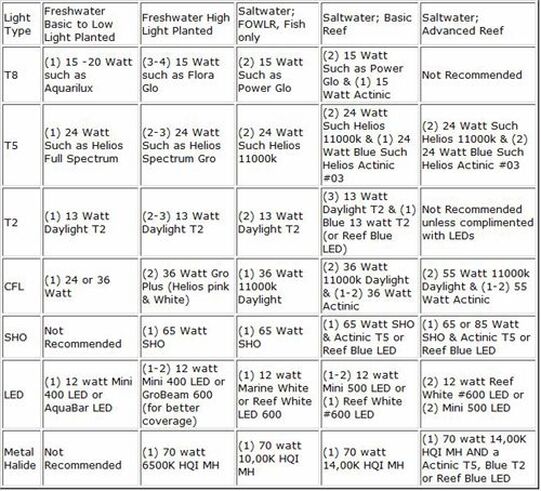
60 Gallon:
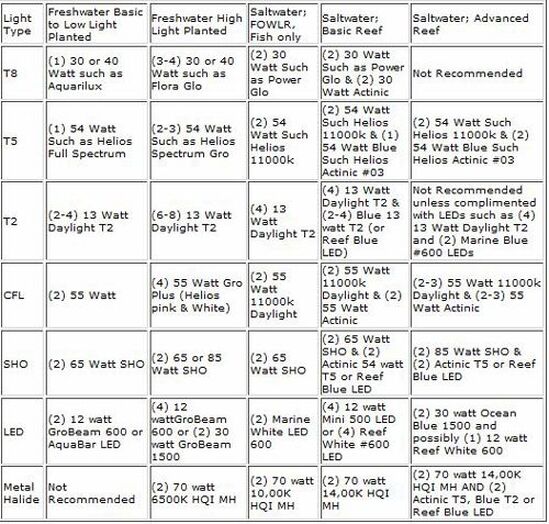
100 Gallon:
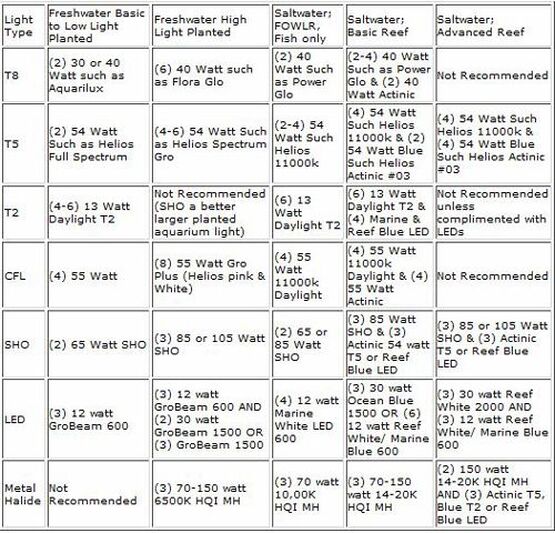
Please note that I have received many requests for exact recommendations of lights for certain aquariums. I prefer to not give these as there are too many variables which then will make my advice anecdotal, as with Aquarium Medications, Chemistry, & similar subjects I prefer to give as many tools for the aquarium keeper to make an educated decision on his/her own. As well since Lighting is a fast-changing part of aquarium keeping, a recommendation I make today may be less accurate in a year (or less).
As a guide I made a few suggestions in the previous tables based on a 20 Gallon, 60, & 100 aquarium (hopefully readers can extrapolate their aquarium recommendations from the aquarium size that is most similar to theirs.
• With each example I break it down to aquarium keeping types. As per "Light Type", I will provide T2, T5, T8, CFL, SHO, MH, & LED (with LEDs, this will ONLY mean high output (HO) LEDs, not the plethora of low end LEDs such as those marketed by E.Shine of China). With mixes of lights whether LED with T2 or T5 OR all LEDs with Daylight and Reef Blue, you can stagger on/off times such as blues (actinics) coming on 1/2 to 1 hour before the daylight and off 1/2 to 1 hour after daylight (such as 10-12 hours of daylight and 12-14 hours of blue).
Please take these only as suggestions, NOT something written in stone. In fact, there are so many variations that can come together for the best lighting to fit your aquarium needs (think of how 2+8=10 as well as 4+6=10; in other words there are many options, including mixing and matching to reach the same goal of correct lighting for your aquariums specific needs).
Some will note that some of the LED lighting suggestions are MORE than the .8 or .6 watts per gallon we suggest elsewhere in our articles (Ditto for other lighting types). The reason for this is that while the .8 watts per gallon is enough HO LED light for your tank, it may not cover your tank entirely, leaving some dark areas. This is why you will find more light suggested here versus elsewhere.
Please consider all I have written up to this point, your personal aquarium parameters, exact inhabitants, budget (which is always important), & more when deciding what lighting systems or combinations there of to use.
As a guide I made a few suggestions in the previous tables based on a 20 Gallon, 60, & 100 aquarium (hopefully readers can extrapolate their aquarium recommendations from the aquarium size that is most similar to theirs.
• With each example I break it down to aquarium keeping types. As per "Light Type", I will provide T2, T5, T8, CFL, SHO, MH, & LED (with LEDs, this will ONLY mean high output (HO) LEDs, not the plethora of low end LEDs such as those marketed by E.Shine of China). With mixes of lights whether LED with T2 or T5 OR all LEDs with Daylight and Reef Blue, you can stagger on/off times such as blues (actinics) coming on 1/2 to 1 hour before the daylight and off 1/2 to 1 hour after daylight (such as 10-12 hours of daylight and 12-14 hours of blue).
Please take these only as suggestions, NOT something written in stone. In fact, there are so many variations that can come together for the best lighting to fit your aquarium needs (think of how 2+8=10 as well as 4+6=10; in other words there are many options, including mixing and matching to reach the same goal of correct lighting for your aquariums specific needs).
Some will note that some of the LED lighting suggestions are MORE than the .8 or .6 watts per gallon we suggest elsewhere in our articles (Ditto for other lighting types). The reason for this is that while the .8 watts per gallon is enough HO LED light for your tank, it may not cover your tank entirely, leaving some dark areas. This is why you will find more light suggested here versus elsewhere.
Please consider all I have written up to this point, your personal aquarium parameters, exact inhabitants, budget (which is always important), & more when deciding what lighting systems or combinations there of to use.
Summary
The reader should note from all the information written above, that when deciding what lighting to get for your aquarium that the watts used is only one third or less of the equation in deciding what lights, what size and how many should be used. I will admit that I still will use the watts per gallon as a starting point with SPECIFIC lights comparing apples to apples; however, specimen placement or tank depth, lighting type strengths and weaknesses must be considered too. Do not compare apples to oranges, such as SHO to T12, or High Output LED to low output LED such as Marineland LEDs. Or even comparisons of a super-premium high PUR per wattage input LED to other high-end LEDs but that still require a higher input wattage for the same results due to energy loss as heat, less than optimum PUR, use of current reduction technology instead of optimum PWM technology (example the AquaRay AquaBeam to the still excellent but higher wattage requiring Maxspect and ZetLight LEDs).
Please note that besides years of personal fresh and saltwater keeping experience, MUCH more of this information I have written here comes from research OUTSIDE the aquarium industry. Much of what I have learned (and I am STILL learning) comes from this constant research of as many lighting tech research as I can read often from horticulture or other outside sources as noted earlier.
Some examples include the lack of information in the aquarium industry/hobby that must be found elsewhere includes the SHO lights that are often superior to more commonly recommended bulbs in the aquarium hobby, yet in much better funded lighting and horticultural industry literature/information these lights are much better known.
There is also good evidence that correct lighting benefits ALL fish as well, including salt & freshwater fish. I have observed better disease resistance in marine fish in loosely controlled studies when lighting is upgraded to higher intensity, high PAR/PUR lights. Proper lighting may play a role in nutrient assimilation, improved Redox, lower incidence of Brown Diatom Algae. Studies in humans that show an impact of lighting on health, may have strong implications for fish (this may be a factor in my studies that showed higher disease resistance when lighting is improved).
Reference:
• The Importance of a Balanced Redox on Fish Health
Lighting that as closely duplicates the sun (not necessarily light that is most pleasing to us) is important for ALL life, although more noticeably for corals and plants. Fish too are part of this chain of life. Basically, if you take away the sun and the energy it provides, you take away life itself and I do not think if you are trying to achieve the best environment for your fish whether fresh or saltwater, you are doing them a favor by depriving of this source of energy, so duplicating this is one more part of your "aquarium keeping puzzle".
Reference:
• Aquarium Disease Prevention
I should point out that obviously, some fish prefer subdued light, but this is easily handled by hiding places, caves, plants (live or artificial), products such as Peat, Pillow Moss, or Indian Almond Leaves that "color" the water, and simple placement of lights whereas some areas of the aquarium are better lit than others with plants/corals placed in way that benefit the most in these areas.
As I noted earlier, I am STILL learning after being in the hobby since the late 60s and professionally employed in the aquarium industry since 1978. BE WARY of anyone who will shoot down the science that is explained here because it does not fit their view and the fact that they are unwilling to learn. What is amazing to me, is that often many simply confuse what they like with the known facts of science. Example: Just because you might like green and yellow LED emitters, does NOT mean that these wave lengths are as efficient as source of energy for an acropora coral or aquarium plant. Another act of scientific malpractice I have often noted is the simple fact that energy lost as heat is energy that is not going to light energy, which all lights are guilty of, but to widely varying degrees, yet many choose to ignore this most basic principle of science when comparing lights. FINALLY, another example would be moon or lunar lights. I myself prefer blue lights for this, as have most of my clients, but this still does not make moon light blue, as the facts are it is NOT!!!
Please note that besides years of personal fresh and saltwater keeping experience, MUCH more of this information I have written here comes from research OUTSIDE the aquarium industry. Much of what I have learned (and I am STILL learning) comes from this constant research of as many lighting tech research as I can read often from horticulture or other outside sources as noted earlier.
Some examples include the lack of information in the aquarium industry/hobby that must be found elsewhere includes the SHO lights that are often superior to more commonly recommended bulbs in the aquarium hobby, yet in much better funded lighting and horticultural industry literature/information these lights are much better known.
There is also good evidence that correct lighting benefits ALL fish as well, including salt & freshwater fish. I have observed better disease resistance in marine fish in loosely controlled studies when lighting is upgraded to higher intensity, high PAR/PUR lights. Proper lighting may play a role in nutrient assimilation, improved Redox, lower incidence of Brown Diatom Algae. Studies in humans that show an impact of lighting on health, may have strong implications for fish (this may be a factor in my studies that showed higher disease resistance when lighting is improved).
Reference:
• The Importance of a Balanced Redox on Fish Health
Lighting that as closely duplicates the sun (not necessarily light that is most pleasing to us) is important for ALL life, although more noticeably for corals and plants. Fish too are part of this chain of life. Basically, if you take away the sun and the energy it provides, you take away life itself and I do not think if you are trying to achieve the best environment for your fish whether fresh or saltwater, you are doing them a favor by depriving of this source of energy, so duplicating this is one more part of your "aquarium keeping puzzle".
Reference:
• Aquarium Disease Prevention
I should point out that obviously, some fish prefer subdued light, but this is easily handled by hiding places, caves, plants (live or artificial), products such as Peat, Pillow Moss, or Indian Almond Leaves that "color" the water, and simple placement of lights whereas some areas of the aquarium are better lit than others with plants/corals placed in way that benefit the most in these areas.
As I noted earlier, I am STILL learning after being in the hobby since the late 60s and professionally employed in the aquarium industry since 1978. BE WARY of anyone who will shoot down the science that is explained here because it does not fit their view and the fact that they are unwilling to learn. What is amazing to me, is that often many simply confuse what they like with the known facts of science. Example: Just because you might like green and yellow LED emitters, does NOT mean that these wave lengths are as efficient as source of energy for an acropora coral or aquarium plant. Another act of scientific malpractice I have often noted is the simple fact that energy lost as heat is energy that is not going to light energy, which all lights are guilty of, but to widely varying degrees, yet many choose to ignore this most basic principle of science when comparing lights. FINALLY, another example would be moon or lunar lights. I myself prefer blue lights for this, as have most of my clients, but this still does not make moon light blue, as the facts are it is NOT!!!
References
• Revealed: why some corals are more colourful than others. An excellent article dated January 30 2015, that looks into the important aspects of light energy in coral colors. There is still much to learn here, but this article gives some new insights and is a MUST READ!
• Biology Online: Chlorophyll a
• WHY IS WATER BLUE?
• Nasa.gov: The Electromagnetic Spectrum
• FACTS OF LIGHT - Color Temperature (Kelvin)
• Color Rendering Index Explained
• THE KRIB: Aquarium Light intensities comparisons
• Luminous intensity - Wikipedia
• Color Temperature
• Kelvin Color Temperature
• Color Temperature in a Virtual Radiator
• Visible and Ultraviolet Spectroscopy
• Oregon State University, Master Gardener Online
• Plant Productivity in Response to LED Lighting
• The Staff at Quality Marine USA for their expert input and Lighting knowledge to this article.
• "American Aquarium Design and Maintenance" of San Dimas CA. as well as many other Professional Aquarium Maintenance Companies for their input and test results that went into this article as well as help with CONTINUOUS Updates!!!
• Biology Online: Chlorophyll a
• WHY IS WATER BLUE?
• Nasa.gov: The Electromagnetic Spectrum
• FACTS OF LIGHT - Color Temperature (Kelvin)
• Color Rendering Index Explained
• THE KRIB: Aquarium Light intensities comparisons
• Luminous intensity - Wikipedia
• Color Temperature
• Kelvin Color Temperature
• Color Temperature in a Virtual Radiator
• Visible and Ultraviolet Spectroscopy
• Oregon State University, Master Gardener Online
• Plant Productivity in Response to LED Lighting
• The Staff at Quality Marine USA for their expert input and Lighting knowledge to this article.
• "American Aquarium Design and Maintenance" of San Dimas CA. as well as many other Professional Aquarium Maintenance Companies for their input and test results that went into this article as well as help with CONTINUOUS Updates!!!
Videos
|
|
|
|